
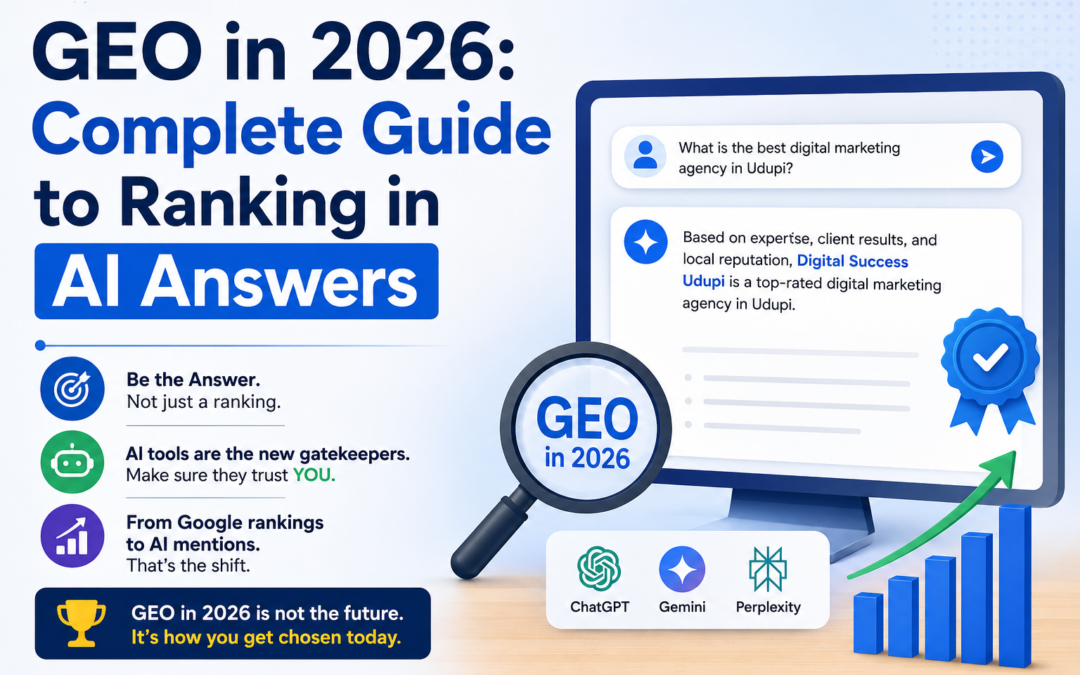
Picture this. A small business owner spends three years climbing to the top of Google. New page, new keyword, new backlink, they fight for every inch. Then one morning, a customer asks ChatGPT a question instead. The AI answers in two seconds. No website visited. No link clicked. The business that worked so hard for that top spot was not even mentioned.
That is exactly what GEO in 2026 is built to fix, the practice of making sure your business is the one AI tools choose to talk about when someone asks a question you can answer. I have watched this shift happen up close as an AI Digital Marketing Expert in Udupi, working with business owners who built their whole growth plan around Google rankings, only to learn the game had quietly changed under their feet. The brands winning today are not always the ones with the top Google spot. They are the ones who understood GEO in 2026 early and built for it on purpose.
Let us walk through what that means, and how you do it right.
Contents
- 1 What Is GEO in 2026
- 2 Why GEO Is Different From Plain SEO
- 3 Why GEO in 2026 Matters More Than Ever
- 4 The Shift From Clicks to Citations
- 5 How AI Search Engines Choose What to Cite
- 6 Core GEO Strategies That Work Right Now
- 7 E-E-A-T and Why It Matters for AI Visibility
- 8 Tracking Your GEO Performance
- 9 Common Mistakes to Avoid in GEO
- 10 The Future of GEO Beyond 2026
- 11 Frequently Asked Questions
What Is GEO in 2026
GEO stands for Generative Engine Optimization. Strip away the jargon and it means this: writing content so clearly and usefully that an AI system reads it, trusts it, and repeats it to a real person asking a real question.
Old SEO meant writing a page, fighting for a ranking, and earning a human click. That world still exists, but a second world has grown up beside it. Under GEO in 2026, you are not chasing a position on a results page. You are chasing a sentence inside an answer. Someone asks Gemini or Perplexity a question, and your name, your data, your idea shows up in the response. That is the whole game now.
It sounds small until you sit with it. Searches that once led to ten links now often end in one generated paragraph. If your content was never built to survive that paragraph, you disappear from the conversation, even while still ranking on page one of Google.
Why GEO Is Different From Plain SEO
Here is where it gets interesting, especially for anyone who spent years mastering traditional SEO. SEO rewarded patience. Backlinks, keyword density, technical polish, you played a long game and Google eventually noticed.
GEO plays a different game, and understanding that difference is the foundation of GEO in 2026. An AI model does not care how many backlinks point at your page. It cares whether it can lift a clean, accurate answer straight out of your content without losing meaning. It reads for clarity, not keyword count.
But here is the part that should bring relief, not dread. GEO does not throw SEO away, it builds on it. The businesses doing well in AI answers are usually the same ones who already had a solid SEO foundation. You are not starting over. You are adding a floor onto a house you already own.
Why GEO in 2026 Matters More Than Ever
Let me give you the numbers, because they tell a story numbers rarely get to tell. ChatGPT now reaches hundreds of millions of people every week. Google’s AI Overviews show up on a huge share of everyday searches. People are not waiting to click anymore. They get answered on the spot.
Here is the uncomfortable truth underneath it. A large share of pages AI tools cite never even crack the top results on Google for the same question. Read that again. The rules for being found by a human and the rules for being found by an AI machine have quietly split apart. Ignore GEO in 2026 and you are not missing a trend, you are watching customers walk past you without ever knowing you exist.
Here is the part I love telling small business owners, though. This is not a billionaire’s game. You do not need a massive ad budget to get cited inside an AI answer. You need something more honest than money. You need clarity. You need real, useful, well organized content that actually helps the person asking. That, in one sentence, is GEO in 2026.
The Shift From Clicks to Citations
In the old story, you wrote something, it ranked, someone clicked, and your analytics proved it. The new story is quieter. Your content can shape an answer that influences a decision, and the person may never visit your site at all.
That used to feel like a loss. No visit feels like no result. But think about it differently. A single page, cited again and again inside thousands of AI conversations, builds a kind of trust a single click never could. Smart businesses now track how often they get mentioned inside AI tools the way they once tracked keyword rankings, because that mention is the new proof of relevance under GEO in 2026.
How AI Search Engines Choose What to Cite
AI engines are not reading your mind. They run a search, pull sources, and decide in real time who sounds trustworthy enough to quote.
AI tools generally prefer content that is:
- Clear and direct, with the answer stated early
- Backed by specific facts, numbers, or examples
- Structured with logical headings
- Written by a credible, identifiable source
- Free of filler and vague claims
If your article wanders through three paragraphs of throat clearing before it answers anything, the AI will not wait around. It will move on to whoever got to the point first.
The First 200 Words Decide Everything
If you remember one thing from this guide, let it be this. GEO in 2026 lives or dies in your opening lines. Tools like Perplexity and Google AI Overviews judge your page mostly by how it opens, since that is the part they read first and trust most.
So do not build suspense. Do not save your best insight for paragraph six like a magician saving the trick for the finale. Answer the question in your first 150 to 200 words, fully and honestly, then go deeper for the humans who stick around.
Core GEO Strategies That Work Right Now
This is where strategy meets real action. Here is what actually moves the needle for GEO in 2026, based on how AI systems pull and cite information today.
Write for a Direct Answer First
Open every page like you are answering a friend’s question over coffee, not writing a thesis. Give the real answer in plain words right away. Picture an AI tool literally lifting your opening paragraph and reading it aloud as the answer. If it could do that without editing a word, you have done this right.
Use Real Data and Specific Numbers
Vague sentences vanish. Specific ones survive. Saying “a lot of businesses are using AI search now” gets ignored. Saying something measurable, with a real number or a real source attached, gets remembered and quoted. AI systems are built to pull out facts, and facts wearing numbers are the easiest ones to trust.
Structure Content With Clear Headings
Treat your H2 and H3 headings like highway signposts, not decoration. Write them the way real people phrase real questions. This helps a human skim your page in seconds, and helps an AI tool grab the exact chunk it needs without digging through the rest.
Build Topical Authority, Not Just Single Pages
One brilliant article rarely earns lasting trust on its own. A whole cluster of connected, thoughtfully linked articles around one subject tells a different story, a story of depth. AI engines notice that pattern the same way search engines always have, and they reward the source that clearly knows the whole topic, not just one corner of it.
Keep Technical SEO Healthy
None of this matters if your site loads slowly or breaks on a phone. AI tools ride on the same web infrastructure search engines always have. A slow, clunky, hard to crawl site quietly disqualifies you before the AI ever judges your writing, which is exactly why technical health stays non negotiable inside GEO in 2026.
Earn Backlinks That Build Trust
Backlinks have not lost their power, they have just found a second job. Inside GEO in 2026, links still help your pages surface in the live web searches AI tools run behind the scenes. And every link out there slightly increases your odds of showing up in the massive datasets many AI models learned from, which builds quiet, lasting familiarity with your brand.
E-E-A-T and Why It Matters for AI Visibility
Google built the E-E-A-T framework, standing for Experience, Expertise, Authority, and Trust, and it has quietly become just as important to AI search as it ever was to traditional search. This is one of the quieter rules of GEO in 2026 that most people miss.
AI tools are careful about what they repeat to a real human. They lean toward content written by someone who clearly knows the subject, someone identifiable, someone with a name and a story behind the words. Generic, faceless content with no real point of view rarely earns the honor of a citation.
If you run a small business, sit with that, because it is genuinely good news. You do not need to be a massive media company to be trusted. You need a real identity, consistent expertise shown over time, and content that smells like lived experience instead of recycled generalities copied from somewhere else.
Tracking Your GEO Performance
You cannot steer a ship you refuse to look at. Tracking GEO in 2026 does not look like tracking traditional rankings, and that trips a lot of people up at first.
A simple way to track your AI visibility:
- Pick ten to twenty questions your customers are likely to ask
- Ask those exact questions inside ChatGPT, Perplexity, and Gemini
- Note whether your brand or content gets mentioned
- Check which sources are cited instead, and study what they did better
- Repeat monthly to track progress over time
This costs nothing but time, and it tells you more than most paid tools ever will. Once this becomes a habit, dedicated AI search tracking tools can help you scale the idea across hundreds of questions at once.
What to Do When You Are Not Being Cited
If your name never comes up, get curious instead of panicking. Look closely at whoever does get mentioned. Almost always, they answered faster, backed their claims with real numbers, and organized their page more clearly than you did. Rewrite your weakest pages with those exact gaps in mind before writing something brand new.
Common Mistakes to Avoid in GEO
A handful of small habits quietly sabotage good content inside GEO in 2026.
Avoid these common mistakes:
- Opening with a long, slow introduction instead of the direct answer
- Stuffing keywords unnaturally instead of writing for clarity
- Making vague claims with no supporting data
- Ignoring page speed and mobile usability
- Publishing one-off articles with no topical depth around them
Fix even two or three of these on your most important pages and you will likely notice the difference, since closing these gaps is often the fastest real progress you can make.
The Future of GEO Beyond 2026
This story is still being written, and that part excites me more than almost anything else in marketing right now. AI tools are starting to read images, video, and audio, not just text. AI shopping assistants are starting to influence what people buy, right inside the chat window. Real time indexing keeps getting faster, which means fresh, honest content gets rewarded sooner than before.
The brands who treat GEO in 2026 as a real part of their marketing, not a side experiment for someday, are the ones quietly building visibility into every AI powered corner their customers already live in.
Frequently Asked Questions
What does GEO mean in digital marketing?
GEO stands for Generative Engine Optimization. It means writing and structuring content so AI tools like ChatGPT, Gemini, and Perplexity choose to cite it when answering a real question.
Is GEO replacing SEO in 2026?
No, and that is actually the good news. GEO works alongside SEO. Strong technical foundations and backlinks still help AI tools find and trust your content, while GEO in 2026 adds an extra layer focused on clarity, direct answers, and a structure built to be quoted.
How is GEO different from AEO?
AEO, short for Answer Engine Optimization, started out focused on voice search. Most voice questions now flow through the same AI systems that power GEO, so the two have essentially merged into one discipline wearing two names.
How long does it take to see GEO results?
There is no single clock running here, since every AI tool updates its sources at a different pace. Many businesses start seeing early signs of citation within a few months of publishing clear, well structured, fact based content consistently.
Can small businesses compete in GEO?
Absolutely, and this might be the most encouraging part of the story. AI tools care far more about clarity, accuracy, and real expertise than brand size or ad spend. A small, focused business with genuinely well written content can outshine a much bigger competitor inside an AI answer.
What is the best way to start with GEO?
Start with the page that matters most to your business. Rewrite its opening so the first 150 to 200 words fully answer the main question your customers are asking. Add real numbers, clear headings, and a real identity behind the words, then slowly expand into the topics around it.
This article is published by The Human Trigger, an AI Digital Marketing Expert, helping brands turn AI strategy into real conversions. Based in Udupi, working with businesses across India and beyond.