
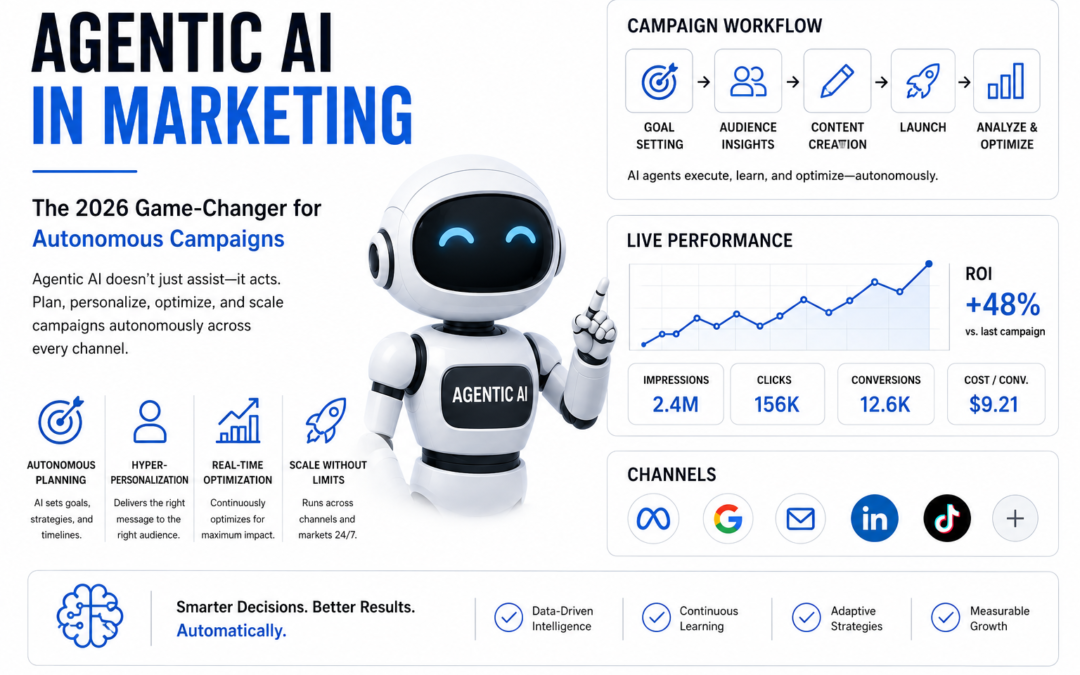
Agentic AI in marketing means AI systems that can plan, decide, and run entire campaigns on their own, without a human approving every move. Unlike regular AI tools that wait for your next prompt, agentic AI sets goals, tests ideas, reads results, and keeps improving, all by itself. In 2026, this shift is changing how brands handle ads, emails, social media, and content. It is not just smarter automation. It is AI that behaves like a seasoned marketing strategist who never sleeps. As an AI Digital Marketing Expert in Udupi, I have watched this shift happen in real time, and the businesses that are moving early are the ones pulling ahead.
Contents
- 1 The Day I Realised Marketing Would Never Be the Same
- 2 What Is Agentic AI in Marketing, Really?
- 3 A Week in the Life of an Agentic AI Marketing System
- 4 Why 2026 Is the Tipping Point
- 5 Where Agentic AI Is Already Doing the Work
- 6 This Is Not Like the Automation You Already Use
- 7 The Human Role Does Not Disappear. It Gets More Important.
- 7.1 You Set the Direction
- 7.2 You Protect the Brand
- 7.3 You Stay in the Room
- 7.4 The Risks Are Real. Here Is How to Handle Them.
- 7.5 Brand Safety Can Slip Fast
- 7.6 Compliance Is Not the AI’s Problem to Solve for You
- 7.7 You Can Optimise Yourself into a Corner
- 7.8 Do Not Let One Platform Own Your Operation
- 7.9 How to Start Without Getting Overwhelmed
- 7.10 Find One Thing That Is Costing You Too Much Time
- 7.11 Choose a Platform That Is Built for Agentic Workflows
- 7.12 Write Your Brand Guardrails Before You Switch Anything On
The Day I Realised Marketing Would Never Be the Same
Picture this. It is 11 PM on a Tuesday. Your Google Ads campaign is quietly burning through budget on the wrong audience. Your email sequence has a broken link in step three. Your Instagram post went live at the wrong time for your target market. And you are asleep, completely unaware.
Now picture a different version of that Tuesday. The AI running your campaigns caught the budget issue at 11:03 PM and shifted spend to a better-performing ad group. It flagged the broken email link before the third subscriber even opened it. It moved the Instagram post to 7:42 AM, the exact time your audience is most likely to engage.
Nobody woke up. Nobody logged in. It just happened.
That is what agentic AI in marketing actually looks like when it is working. Not a chatbot. Not a copy generator. A thinking, acting, self-correcting system that runs your marketing the way a great operations manager would run your office.
This is not science fiction. This is 2026.
What Is Agentic AI in Marketing, Really?
Let us get this clear before we go further, because a lot of people are confusing agentic AI with regular AI tools, and that confusion is costing them.
Most AI tools you use today are reactive. You ask, they answer. You prompt, they produce. They are brilliant assistants, but they wait for you.
Agentic AI in marketing is proactive. It does not wait. You give it a goal, and it goes after that goal using whatever tools, data, and decisions are needed to get there. It plans. It acts. It checks the results. It adjusts. It keeps going.
Here is an analogy that might make this land better.
Imagine you hire a freelance copywriter. Every time you need something written, you brief them, they write it, they send it back, and you review it. That is generative AI. Useful, but fully dependent on you to keep the wheel turning.
Now imagine you hire a head of marketing. You tell them: “We need to grow qualified leads by 30% this quarter.” And then they go do it. They build a content calendar, run the ad campaigns, test the landing pages, adjust the messaging when something is not working, and report back with results.
That is agentic AI in marketing. Not a tool you use. A system that works.
And in 2026, this is no longer an enterprise-only luxury. It is becoming table stakes.
A Week in the Life of an Agentic AI Marketing System
The best way to understand how agentic AI in marketing actually operates is to follow it through a real campaign, step by step.
Monday Morning – The Brief
You sit down and tell the system: “I want 400 trial signups in the next 21 days. Our budget is Rs. 60,000 across Google and Meta. Focus on small business owners aged 28 to 45.”
That is the entire brief.
The agentic AI does not wait for you to write ad copy, choose audiences, or set bids. It pulls your past campaign data, studies which audience segments converted best, looks at what your competitors are running, identifies keyword gaps in your paid search coverage, and builds a full launch plan within minutes.
Tuesday – Launch Day
The campaign goes live. Ten Google ad variants. Six Meta creatives. Two landing page versions. Three email sequences for leads that come in via different channels. All of it running simultaneously.
A human team would need a week to build this. The AI built it overnight.
Thursday – The Pivot
By Thursday, the data is talking. One Google ad is getting a 6.8% click-through rate. Another is sitting at 1.2%. On Meta, one creative is generating signups at Rs. 87 cost per acquisition. Another is at Rs. 312.
Without anyone touching a dashboard, the agentic AI in marketing pauses the underperformers, reallocates the budget to what is working, generates two new creative variants based on the winning format, and launches them.
The Following Monday – Report and Learn
You get a performance summary. 218 signups in 7 days, trending toward your 400-signup goal. The AI flags two audience segments it discovered are converting unexpectedly well and asks if you want it to shift more budget there.
You say yes. It handles the rest.
That is what agentic AI in marketing does week over week. Not one clever trick. A continuous loop of action, learning, and improvement.
Why 2026 Is the Tipping Point
People have been talking about autonomous AI for years. So why is 2026 the year that actually matters?
A few things changed at the same time, and they changed fast.
The Integrations Finally Work
Agentic AI needs to plug into your real marketing stack to be useful. Your CRM, your ad platforms, your email tool, your analytics. For years, those connections were clunky, partial, or required expensive custom development.
By 2026, the major agentic AI platforms come pre-wired to the tools your team already uses. The friction that made early adoption painful has mostly disappeared.
The Reasoning Got Sharper
Earlier AI models could follow instructions well but struggled with nuance. They would make decisions that made sense in isolation but fell apart when you looked at the bigger picture.
The models powering agentic AI in marketing today handle multi-step reasoning far better. They hold context across a full campaign cycle, not just a single task. They catch contradictions. They know when to ask a clarifying question and when to just make a judgment call.
The Cost Came Down
Running an autonomous AI marketing system used to require infrastructure that only well-funded teams could afford. That is no longer the case. In 2026, small agencies and solo operators can access agentic AI capabilities through monthly SaaS subscriptions, at a price point that is a fraction of what a junior marketing hire would cost.
The Gap Between Early Movers and Everyone Else Is Showing
Here is the uncomfortable truth. The brands and agencies that started testing agentic AI in marketing 18 months ago have compounding advantages now. Lower cost per acquisition. Faster campaign cycles. Better audience data. More refined AI outputs.
They are not just ahead. They are pulling further ahead every week.
Where Agentic AI Is Already Doing the Work
This is not theoretical anymore. Here is where autonomous AI systems are actively running marketing operations in 2026.
Paid Advertising That Manages Itself
Paid media is where agentic AI in marketing shows its sharpest teeth. It runs 24 hours a day across every platform you are on. It adjusts bids in real time. It rotates ad creatives based on performance data. It pauses campaigns that are bleeding budget and doubles down on what is generating returns.
The average human PPC manager, no matter how skilled, is checking in a few times a day. Agentic AI never blinks.
For businesses running ads across Google, Meta, and programmatic networks at the same time, the efficiency gains are significant. Less waste. Better targeting. More consistent returns.
Email Marketing That Thinks About the Individual
Most email marketing is still built around segments. You send version A to list group one. Version B to list group two. It is better than a blast, but it is still a blunt instrument.
Agentic AI in marketing changes this completely. It looks at each subscriber individually, what they clicked, what they ignored, how long they spent on your website, which product pages they visited, and it builds a unique sequence for each person based on that behavior.
This is not just personalization. This is individualization at scale. And it runs without anyone manually configuring a single workflow.
Content That Finds Its Own Topics
One of the least exciting but most time-consuming parts of content marketing is research. What should we write about? Which keywords are worth targeting? What gaps exist in our current coverage?
Autonomous AI agents handle all of this now. They monitor search trend shifts, identify gaps in your content strategy, surface topics your competitors are ranking for that you are not, and draft briefs or full articles, queued and ready for your review.
For content-heavy brands and agencies, this alone changes the economics of the entire operation.
Social Media That Reads the Room
Timing, tone, platform context. Social media is full of variables that matter enormously but are hard to optimize manually. Agentic AI in marketing handles the operational layer: scheduling, creative testing, best-time-to-post optimization, even detecting engagement spikes and pushing follow-up content out while the momentum is still hot.
Lead Nurturing That Stays Patient
Most leads do not buy on the first visit. Or the second. Or the fifth. Nurturing those leads over weeks and months without losing the human feel is one of the hardest things in B2B marketing.
Autonomous marketing agents do this with patience that no human team can sustain. They track where every lead is in the buying journey, send contextually relevant content at the right intervals, flag the moment a lead shows strong purchase intent, and pass them to the sales team with a full behavioral history attached.
This Is Not Like the Automation You Already Use
At this point, a fair question comes up. We already have marketing automation. What makes this so different?
It is a reasonable question, and the difference is worth understanding clearly.
Traditional marketing automation follows a script you wrote. You set up the if-then rules. If someone downloads a lead magnet, send this email. If they click this link, move them to this list. The system executes your logic, nothing more.
Agentic AI in marketing writes its own script. You give it a goal. It figures out the logic. It builds the rules, tests them, discards what does not work, and builds new rules. It gets smarter the longer it runs.
Think of traditional automation as a very reliable employee who does exactly what the job description says, nothing more, nothing less. Agentic AI is the employee who reads the job description, sees what you actually need, and finds a better way to do it.
That is a meaningful difference. And for teams that are already stretched thin, that difference is everything.
The Human Role Does Not Disappear. It Gets More Important.
Let us address the fear in the room. Because every time a new technology takes over repetitive work, the same question comes up. What happens to us?
The honest answer with agentic AI in marketing is this: the work does not disappear, it shifts upward.
You Set the Direction
Agentic AI executes toward a goal. It does not choose what the goal should be. The strategic thinking, the business context, the decision about which market to chase and which to ignore, that is still entirely human.
A system can optimise your campaign to drive trial signups. It cannot tell you whether trial signups are the right goal for this stage of your business.
You Protect the Brand
AI systems work within the guardrails you set. But those guardrails only exist because a human defined what the brand stands for, what it will and will not say, what its voice sounds like, and where the lines are.
Brands that rush into agentic AI without doing this work first end up with campaigns that are fast but hollow.
You Stay in the Room
Even the best agentic AI in marketing makes decisions that a human needs to review. Not every day, not for every small move, but regularly. You need to know when the system is drifting from your strategic intent and be willing to step in and reset it.
The best marketing professionals in 2026 are not the ones who know the most tools. They are the ones who know how to direct powerful systems toward the right outcomes.
The Risks Are Real. Here Is How to Handle Them.
Agentic AI in marketing is genuinely useful, but it comes with pitfalls that are worth naming honestly.
Brand Safety Can Slip Fast
An autonomous system that can publish content and run ads at scale can also publish the wrong content and run the wrong ads at scale. Without proper brand guardrails built in from the start, things can go sideways quickly.
The fix is not complicated, but it does require discipline. Document your brand voice, your restricted topics, your visual guidelines, and your compliance requirements before you deploy anything. Build them into the system. Audit outputs regularly, especially in the first 90 days.
Compliance Is Not the AI’s Problem to Solve for You
Agentic AI in marketing processes customer data at speed. GDPR in Europe, the DPDP Act in India, CCPA in California. These regulations do not care that your AI was acting autonomously. If your system mishandles customer data, the liability lands with you.
Build compliance requirements into your AI configuration from day one. Do not treat it as something you will add later.
You Can Optimise Yourself into a Corner
AI agents are ruthless optimizers. Give them the wrong metric and they will hit it perfectly while completely missing the point. If you tell the system to maximize click volume and nothing else, it will find clicks. Not necessarily buyers. Not necessarily the right audience.
Be precise about what you are actually trying to achieve, and build secondary guardrails around the metrics you cannot afford to sacrifice.
Do Not Let One Platform Own Your Operation
If your entire autonomous marketing setup runs through a single vendor and that vendor changes pricing, goes offline, or alters their policy, your campaigns go dark. Spread your critical operations across more than one system wherever possible.
How to Start Without Getting Overwhelmed
You do not need to hand over your entire marketing operation to an AI system on Monday morning. In fact, please do not.
Here is a more sensible path in.
Find One Thing That Is Costing You Too Much Time
What task is your team doing repeatedly that has clear inputs, clear outputs, and a measurable success metric? Paid ad bid management is a classic starting point. So is email sequence optimization. Start there.
Choose a Platform That Is Built for Agentic Workflows
Look for tools that manage toward goals, not just execute rules. In 2026, platforms like Salesforce Agentforce, Google’s AI Max for Performance Max, and several specialist marketing AI agents are moving clearly in this direction.
Write Your Brand Guardrails Before You Switch Anything On
This step is not optional. Your brand voice document, your content restrictions, your tone guidelines, your compliance requirements. These need to exist in writing
This article is published by The Human Trigger, an AI Digital Marketing Expert, helping brands turn AI strategy into real conversions. Based in Udupi, working with businesses across India and beyond.