
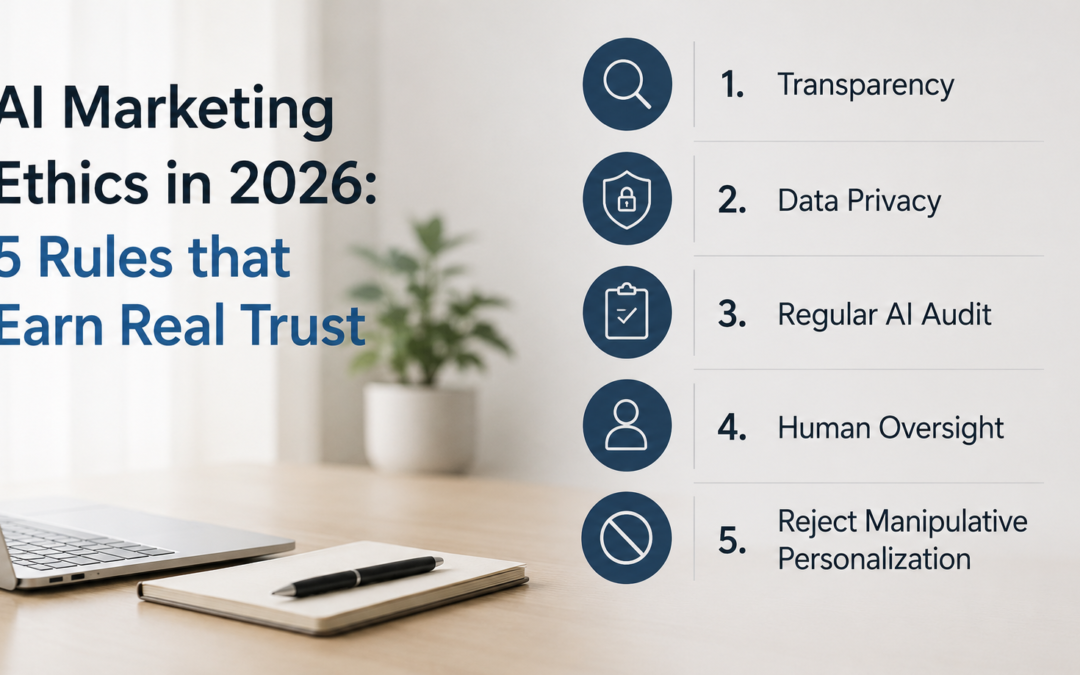
AI marketing ethics is the practice of using artificial intelligence in marketing campaigns with honesty, fairness, and full transparency. In 2026, brands that follow strong AI marketing ethics principles avoid public backlash, stay ahead of regulators, and build the kind of customer trust that no ad budget can buy. The five core rules are: be transparent about AI use, protect consumer data, audit for algorithmic bias, keep humans in the loop, and reject manipulative personalization.
Contents
- 1 The Day AI Marketing Ethics Became Personal for Me
- 2 What AI Marketing Ethics Actually Means in 2026
- 3 Rule 1: Transparency Is the Foundation of AI Marketing Ethics
- 4 Rule 2: Data Privacy Is Non-Negotiable in Ethical AI Marketing
- 5 Rule 3: Audit Your AI Regularly for Bias
- 6 Rule 4: Human Oversight Is a Core Principle of AI Marketing Ethics
- 7 Rule 5: Reject Manipulative Personalization
- 8 The Real Business Case for AI Marketing Ethics
- 9 How to Start Building Your AI Marketing Ethics Framework Today
- 10 Frequently Asked Questions About AI Marketing Ethics
- 10.1 What is AI marketing ethics?
- 10.2 Why does AI marketing ethics matter more in 2026 than before?
- 10.3 How do I make my AI marketing campaigns more transparent?
- 10.4 What separates personalization from manipulation in AI marketing?
- 10.5 Where should I start with building an AI marketing ethics framework?
The Day AI Marketing Ethics Became Personal for Me
I remember sitting in a client meeting sometime in early 2024. A mid-size e-commerce brand had just launched an AI-powered personalization engine. Open rates were up. Click-throughs were climbing. The client was thrilled.
Then a customer posted a screenshot on X.
The AI had been sending emotionally targeted emails to users it identified as financially stressed, nudging them toward high-ticket purchases with urgency language like “last chance” and “only for you.” No human had reviewed those emails. No human had approved that targeting logic. The AI just learned that it worked, and kept doing it.
Within 72 hours, that brand’s social media comments section became a warzone.
That meeting changed how I think about everything we do in this industry. Because here is the truth nobody tells you when you are excited about your new AI marketing stack: the technology moves faster than the wisdom to use it responsibly. And when that gap gets exposed, it is your brand that pays the price.
This is exactly why AI marketing ethics is not a side conversation in 2026. It is the main conversation. As an AI digital marketing expert in Udupi, I have seen this shift hit businesses of every size, from local startups to established brands scaling across markets.
What AI Marketing Ethics Actually Means in 2026
Let us clear something up right away. AI marketing ethics is not about slowing down your campaigns or adding legal disclaimers to every email. It is not a constraint. It is a competitive advantage.
AI marketing ethics is the framework that decides how your brand uses AI tools, what data you collect, how you target people, what your AI says on your behalf, and where you draw the line between smart marketing and outright manipulation.
In 2026, three forces have made AI marketing ethics unavoidable for every marketer and business owner.
First, regulations. The EU AI Act is now in force. India’s Digital Personal Data Protection Act is tightening. The FTC in the United States is actively investigating AI-driven advertising practices. If your AI marketing strategy does not have an ethics layer built in, you are one audit away from a serious problem.
Second, consumers. A 2025 Edelman Trust Barometer survey found that 68% of global consumers say they will stop buying from a brand they believe is using AI to manipulate them. Your customers are paying attention now. They were not three years ago.
Third, talent. The best marketers and AI specialists want to work for brands that stand for something. Poor AI marketing ethics is a talent repellent.
So if you are a business owner or an AI marketer reading this, understand that AI marketing ethics is no longer optional. It is infrastructure.
Rule 1: Transparency Is the Foundation of AI Marketing Ethics
You cannot build trust on a hidden process.
When a customer chats with your support bot, do they know it is a bot? When your AI writes a weekly newsletter and sends it under the founder’s name, is that disclosed? When your targeting algorithm decides who sees your Facebook ad and who never does, can you explain that decision to a regulator in plain English?
Transparency is where AI marketing ethics starts. And it is where most brands quietly fail.
What Transparency Looks Like in Practice
Add a visible label on AI-generated content in high-stakes categories like health, finance, insurance, and legal services. Train your chatbots to identify themselves clearly when a user directly asks if they are human. Publish a short, plain-language page on your website that explains how your brand uses AI. In email marketing, do not let AI write deeply personal messages and pass them off as hand-typed notes from your CEO unless a real human reviewed, edited, and approved every word.
This level of honesty feels uncomfortable at first. But customers reward it. Brands that are upfront about their AI use consistently report higher trust scores than brands that hide it.
The moment you stop hiding AI in your process is the moment your audience starts trusting your brand again.
Rule 2: Data Privacy Is Non-Negotiable in Ethical AI Marketing
Data is the engine of every AI marketing system. But that data belongs to real human beings who trusted you with it.
Ethical AI marketing means treating that data like a responsibility, not a resource to be mined without limits.
The practices that most commonly violate AI marketing ethics around data are: collecting behavioral data without informed consent, feeding customer data into third-party AI tools without disclosing it in your privacy policy, using purchase history or browsing patterns to build psychological profiles for exploitation, and retaining data far longer than the customer relationship justifies.
Building a Privacy-First AI Marketing Stack
Audit every AI tool in your marketing stack today. For each one, answer these three questions: Where does this tool store my customer data? Who else has access to it? Does using this tool require an update to my privacy policy?
If you cannot answer all three cleanly, that tool is a risk.
A privacy-first approach to AI marketing does not mean collecting less data. It means collecting the right data, for the right purpose, with the right consent. That discipline is at the core of responsible AI marketing ethics and it is what separates brands that customers trust from brands that customers tolerate.
Rule 3: Audit Your AI Regularly for Bias
This is the rule that makes most marketing teams uncomfortable. Because fixing it requires admitting the problem first.
AI systems learn from historical data. Historical data reflects decades of human bias, across gender, age, income level, geography, and ethnicity. That means your AI can inherit those biases and amplify them at scale, without anyone in your team intending it.
Here is a pattern that comes up in AI marketing ethics conversations constantly: a brand trains its ad targeting AI on past customer purchase data. Because certain products were historically bought by a narrow demographic, the AI keeps targeting that group and ignoring everyone else. Nobody programmed it to discriminate. The algorithm figured out what worked historically and repeated it. The result is systematic exclusion, and in many markets, it is now legally actionable.
Algorithmic bias is one of the most urgent challenges in AI marketing ethics today.
How to Audit AI Campaigns for Bias
Run a quarterly review comparing who your AI campaigns are actually reaching against who your product is designed to serve. Look at the data your AI tools were trained on and ask whether it represents your full target audience. Bring in an outside reviewer at least once a year specifically to evaluate your AI outputs for unintended patterns. Document your findings. Build a remediation process.
Sound like a lot of work? It is far less work than managing a public bias scandal.
Rule 4: Human Oversight Is a Core Principle of AI Marketing Ethics
AI is fast. AI does not get tired. AI does not take lunch breaks.
But AI also does not feel. It does not understand what is happening culturally on a given Tuesday morning. It does not notice when a segment of your audience is grieving a national tragedy and your scheduled campaign is about to land with catastrophic tone-deafness. It does not catch the moment when a generated ad copy has an accidental double meaning that will go viral for the wrong reasons.
Human oversight is not a sign that you distrust your AI tools. It is a sign that you understand their limits. And understanding limits is the mark of a mature AI marketing ethics practice.
Where to Keep Humans in Control
Content creation: AI drafts, a human refines and approves before anything goes live. Customer service: AI handles the volume, humans handle anything emotional, complex, or high-stakes. Ad targeting: AI optimizes for performance, humans set the ethical guardrails around audience selection. Crisis communication: this one is absolute. No AI-generated message goes out during a PR crisis without senior human review and sign-off.
The brands getting this right in 2026 treat AI as the engine and human judgment as the steering wheel.
Rule 5: Reject Manipulative Personalization
Here is the rule that creates the most internal debate in marketing teams. Because manipulative personalization often delivers short-term results that look great in dashboards.
But it is a trap. And it sits at the darkest edge of AI marketing ethics violations.
Modern AI can detect when a user is anxious from their browsing patterns. It can identify financial stress signals from purchase behavior. It can time an ad to hit precisely when someone is emotionally vulnerable. And it can do all of this at scale, across millions of users, in real time.
Using AI to exploit those moments is manipulation. It is not marketing.
Drawing the Line Between Personalization and Exploitation
Smart, ethical personalization looks like: recommending products based on genuine past preferences, sending a loyalty reward on a customer’s anniversary, showing location-relevant content that saves someone time.
Manipulative AI marketing looks like: AI-generated fake countdown timers designed to manufacture urgency that does not exist, dynamic pricing that charges more to users the algorithm has flagged as desperate, synthetic social proof created by AI to simulate popularity, targeting users during moments of emotional vulnerability with high-pressure offers.
AI marketing ethics demands that you know where that line is and that you train your team and your tools to stay on the right side of it.
The Real Business Case for AI Marketing Ethics
Let me speak directly to the business owners reading this.
You might be thinking: this all sounds good, but does ethical AI marketing actually grow revenue?
Yes. Here is how.
Trust is the highest-converting asset a brand can own. Customers who trust your brand buy more frequently, spend more per transaction, refer more often, and churn less. No AI campaign produces those numbers on its own. Trust produces those numbers. And AI marketing ethics is what builds trust at scale.
Beyond revenue, consider risk. Regulatory fines for AI misuse in marketing are now reaching seven figures in multiple jurisdictions. A single data breach caused by a poorly vetted AI tool can cost more than your entire annual marketing budget. The cost of doing AI marketing ethics right is a fraction of the cost of getting it wrong.
And then there is reputation. In the age of screenshots and viral posts, one exposed unethical AI practice can undo years of brand building in a news cycle.
Ethical AI marketing is not the slow path. It is the smart path.
How to Start Building Your AI Marketing Ethics Framework Today
You do not need a 60-page policy document. You need five honest actions.
Appoint an owner. Someone in your marketing team needs to be responsible for AI marketing ethics. It does not have to be a full-time role. It has to be someone’s real responsibility.
Audit your tools. List every AI tool in your marketing stack. Document what data each one uses, what decisions it influences, and whether its use is disclosed in your privacy policy.
Build a pre-launch checklist. Every AI-assisted campaign should pass a simple internal review before it goes live. Five questions: Is this transparent? Is the data use consented? Could this be perceived as manipulative? Has a human reviewed it? Does it align with our brand values?
Create a feedback loop. Monitor campaign outcomes for unintended effects. Build a process for flagging and fixing issues quickly.
Tell your audience. A short, honest statement on your website about how you use AI responsibly is a trust signal that most of your competitors are not using yet. Use it.
Frequently Asked Questions About AI Marketing Ethics
What is AI marketing ethics?
AI marketing ethics is the set of principles and practices that guide how businesses use artificial intelligence in marketing responsibly. It covers transparency, data privacy, bias prevention, human oversight, and the rejection of manipulative tactics.
Why does AI marketing ethics matter more in 2026 than before?
Consumer awareness of AI is significantly higher in 2026, regulatory frameworks like the EU AI Act are now enforced, and the reputational consequences of AI misuse are faster and more severe than ever. Brands cannot afford to treat AI marketing ethics as optional.
How do I make my AI marketing campaigns more transparent?
Label AI-generated content in high-stakes contexts, train chatbots to identify themselves as automated systems, and publish a clear page on your website explaining how your brand uses AI in its marketing operations.
H3: What is algorithmic bias and how does it affect AI marketing?
Algorithmic bias occurs when an AI system produces unfair outcomes because it learned from historically biased data. In marketing, this can cause certain audience groups to be unfairly excluded from ad targeting, creating both ethical violations and legal liability.
What separates personalization from manipulation in AI marketing?
Personalization serves the customer by making their experience more relevant. Manipulation exploits the customer by targeting their vulnerabilities, creating false urgency, or pressuring decisions they would not make under neutral conditions. AI marketing ethics requires brands to know and enforce that distinction.
Is there a legal requirement for AI marketing ethics compliance?
In many markets, yes. The EU AI Act, GDPR, CCPA, India’s DPDPA, and FTC guidelines all have direct implications for how AI can be used in marketing. These requirements are expanding globally throughout 2026.
Where should I start with building an AI marketing ethics framework?
Start by appointing an owner, auditing every AI tool in your stack, creating a pre-launch ethics checklist, and publishing a public statement about how your brand uses AI responsibly.
This article is published by The Human Trigger, an AI Digital Marketing Expert, helping brands turn AI strategy into real conversions. Based in Udupi, working with businesses across India and beyond.