
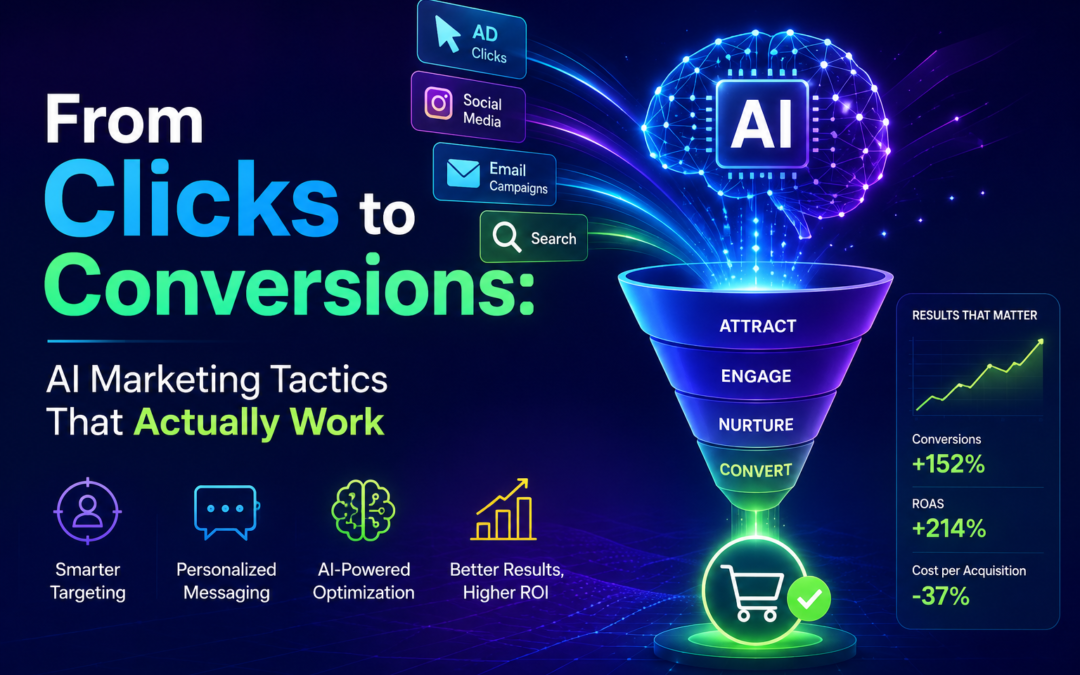
AI marketing tactics that actually work combine three things: understanding what customers really want, personalizing every step of their journey, and following up at exactly the right moment. The best results come from predictive analytics, AI chatbots, dynamic content, and smart email automation, all guided by human strategy. Businesses that use AI marketing tactics that actually work don’t just get more traffic. They turn that traffic into paying customers.
Contents
- 1 Why Traffic Alone Doesn’t Pay the Bills
- 2 What Makes AI Marketing Tactics Actually Work (And What Doesn’t)
- 3 They Save Time Without Losing the Human Touch
- 4 AI Marketing Tactics That Actually Work in 2026
- 4.1 1. Predictive Lead Scoring
- 4.2 2. AI-Powered Chat for Instant Answers
- 4.3 3. Dynamic Content That Adjusts in Real Time
- 4.4 4. Smarter Email Sequences
- 4.5 5. AI-Assisted Content Creation (With Human Editing)
- 4.6 6. Voice Search and Conversational Optimization
- 4.7 7. AI-Driven Retargeting
- 4.8 8. Sentiment Analysis for Customer Feedback
- 5 How to Start Using AI Marketing Tactics That Actually Work (Even With a Small Budget)
- 6 Common Mistakes That Make AI Marketing Fail
- 7 The Real Secret Behind AI Marketing Tactics That Actually Work
- 8 Frequently Asked Questions
Why Traffic Alone Doesn’t Pay the Bills
You’ve felt it. Your website gets visitors. Your social posts get likes. Your ads get clicks. But your sales numbers stay flat.
It’s one of the most frustrating problems in marketing today. Traffic without conversions is just noise. It feels like pouring water into a bucket full of holes. You watch the numbers go up on one dashboard while your bank balance stays exactly where it was last month.
Here’s the good news. AI marketing tactics that actually work aren’t about chasing more traffic. They’re about understanding the traffic you already have and gently guiding it toward a decision.
As an AI Digital Marketing Expert in Udupi, I’ve watched this exact problem play out again and again, for small local businesses and growing brands alike. A shop owner runs ads, gets hundreds of clicks, and still wonders why the phone isn’t ringing. A startup founder posts daily on LinkedIn, builds a following, but struggles to turn that attention into actual deals. The pattern is almost always the same. The fix is never “do more marketing.” It’s “do smarter marketing.” And that’s exactly the kind of work I help businesses put into action, day after day.
That’s the shift this article is about.
What Makes AI Marketing Tactics Actually Work (And What Doesn’t)
Not every “AI tool” delivers results. Some are flashy. Some are overhyped. Some look amazing in a demo video and fall apart the moment real customers touch them. The tactics that genuinely work, the ones worth your time and budget, share three traits.
They Focus on Intent, Not Just Behavior
Knowing someone visited your pricing page is behavior. Knowing why they visited, and what they need to feel confident before buying, is intent. AI models trained on intent signals (time on page, scroll depth, repeat visits, search queries) help respond to the real question a customer is asking.
Think about it this way. If someone visits your pricing page three times in two days, they’re not just browsing. They’re comparing. They’re talking themselves into it, or talking themselves out of it. AI marketing tactics that actually work catch that signal and respond to it, often before your sales team even notices.
They Personalize Without Feeling Creepy
Good personalization feels like a helpful shop assistant who remembers your name and your usual order. Bad personalization feels like being followed around a store by someone whispering “buy this” every five steps. AI marketing tactics that actually work use personalization to remove friction, never to manipulate.
The line between helpful and creepy is thinner than most businesses realize. A returning visitor seeing “Welcome back, here’s what’s new” feels warm. A returning visitor seeing an ad that knows exactly what they searched for last night, on a completely different app, feels invasive. The best marketers use AI to walk that line carefully.
They Save Time Without Losing the Human Touch
The best AI tools handle repetitive work (sorting leads, drafting content, scheduling follow-ups) so your team can spend energy on strategy, creativity, and real relationships. AI should free up your best people to do their best thinking, not replace the thinking entirely.
AI Marketing Tactics That Actually Work in 2026
This is where it gets exciting. Each tactic below has a clear purpose, and each one is something I help clients set up, test, and refine until it actually moves the needle.
1. Predictive Lead Scoring
Instead of treating every lead the same, AI studies patterns from past customers (pages visited, response speed, content downloaded) and predicts which new leads are most likely to convert.
Why it works: Your sales team stops chasing cold leads and starts focusing on warm ones. Imagine your team had a list of one hundred leads, and AI quietly whispered, “these twenty are ready, focus here first.” That’s the practical impact. This single shift can lift conversion rates significantly, and it’s one of the first AI marketing tactics that actually work I set up for new clients, because the results show up fast and the cost is low.
2. AI-Powered Chat for Instant Answers
Visitors leave websites the moment they can’t find an answer. They don’t wait. They don’t email. They just close the tab and move to the next option. AI chat tools respond instantly, day or night, in a natural and friendly tone, answering the small questions that quietly stop people from buying.
This is one of the simplest AI marketing tactics that actually work, especially for service-based businesses where trust and speed decide the sale. A potential client asking “do you work with businesses my size” at eleven at night shouldn’t have to wait until morning for an answer.
3. Dynamic Content That Adjusts in Real Time
Picture your homepage showing different headlines, images, or offers depending on whether a visitor is brand new or a returning customer close to buying. A first-time visitor might see “New here? Start with our free guide.” A returning visitor close to purchasing might see “Ready to get started? Here’s a quick way to begin.”
AI makes this possible without building dozens of separate pages by hand. The page adapts itself, quietly, based on who’s looking at it.
4. Smarter Email Sequences
AI tracks when someone opens an email, what they click, and what they ignore, then adjusts the next message automatically. Instead of one generic follow-up for everyone, each person gets a sequence built around their own behavior.
Someone who clicked on a pricing link gets a different next email than someone who only opened the message and closed it. This kind of small adjustment, repeated across thousands of emails, adds up to a real difference in revenue.
5. AI-Assisted Content Creation (With Human Editing)
AI can draft blog outlines, ad copy, and social captions fast. It can generate ten headline ideas in the time it takes to make a cup of tea. But brands that win never publish raw AI output. They use AI as a first draft tool, then add real stories, original opinions, and brand voice on top.
This is exactly why AI marketing tactics that actually work always pair automation with human judgment, and it’s the core philosophy behind every campaign I build. AI gives you speed. Humans give you soul. You need both.
Founders often ask me how to scale their personal voice alongside their brand’s voice, especially when they’re posting content almost every day and starting to feel stretched thin. A friend of mine has built her entire practice around this challenge, working as the Best AI Personal Branding Consultant for Founders and CXOs in India. Her approach lets AI handle the drafts, research, and structure, while leadership perspective, lived experience, and personal stories shape the final word, every single time. A founder’s voice is one of the most valuable marketing assets a company has, and it’s worth protecting carefully.
6. Voice Search and Conversational Optimization
More people are speaking questions out loud to their phones and smart speakers. Instead of typing “best AI marketing tools,” they’re asking, “what are the best AI marketing tools for small businesses right now?”
Content written in a natural, question-and-answer style, like this article, performs better in voice search results. AI marketing tactics that actually work include writing the way people actually talk, not the way old-school SEO articles used to be written, stuffed with awkward phrases just to hit a keyword count.
7. AI-Driven Retargeting
Not everyone buys on the first visit, and that’s completely normal. Most people need several touchpoints before they feel ready. AI retargeting shows ads based on what someone actually looked at, not a broad generic category. Someone who viewed a specific product sees an ad for that exact product, often with a small nudge like a limited offer or social proof.
This feels less like advertising and more like a gentle reminder, which is exactly why it works.
8. Sentiment Analysis for Customer Feedback
AI scans reviews, comments, and survey responses to spot patterns in how customers feel. Maybe dozens of reviews mention slow delivery. Maybe customers keep praising one specific feature without anyone on the team realizing it’s their biggest selling point.
This helps brands fix small problems before they grow, and double down on what people already love. It’s like having thousands of conversations summarized into a few clear takeaways.
How to Start Using AI Marketing Tactics That Actually Work (Even With a Small Budget)
You don’t need a massive budget or a data science team to begin. Here’s the simple path I walk clients through:
- Start with one tool, not ten. Pick the area causing the most friction (slow responses, low email opens, weak lead quality) and fix that first. Trying to fix everything at once usually means fixing nothing well.
- Feed AI with good data. AI tools are only as smart as the information you give them. Clean customer data leads to sharper predictions. Messy, outdated data leads to confident, wrong answers.
- Test small, then scale. Run a pilot with one email sequence or one chatbot flow before rolling it out everywhere. Watch the numbers for a few weeks before expanding.
- Keep a human in the loop. Review AI suggestions before they go live. This protects your brand voice and builds real trust with your audience. AI can draft the email. A human should still hit send.
If you’d rather have someone set this up for you, this is exactly the kind of work I do for businesses ready to move from clicks to conversions. Most of my clients start with one or two tactics, see early results, and then build from there.
Common Mistakes That Make AI Marketing Fail
Even good tools fail when used the wrong way. I see these mistakes constantly, often from businesses that bought expensive software and never got the results they were promised.
- Automating too early. If your process is broken, AI just speeds up the broken process. A confusing checkout page with a faster chatbot is still a confusing checkout page.
- Ignoring data quality. Garbage in, garbage out still applies, even with the smartest AI. Old contact lists and duplicate records will quietly sabotage your results.
- Removing all human review. Customers can tell when content feels robotic. Authenticity still wins, every time, no matter how advanced the technology gets.
- Chasing every new tool. Focus beats novelty. Master one tactic before adding another. There will always be a newer, shinier tool next month.
The Real Secret Behind AI Marketing Tactics That Actually Work
Here’s something most articles won’t tell you. The tools matter less than the mindset.
AI works best when it’s treated as a thinking partner, not a replacement for strategy. The brands seeing real results aren’t the ones with the fanciest software. They’re the ones asking better questions: Who is this customer? What do they need right now? How can we make this easier for them?
AI answers those questions faster. But the questions still come from people who understand the business, care about the customer, and aren’t afraid to keep refining the approach.
That’s the heart of AI marketing tactics that actually work. Technology amplifies good strategy. It never replaces it. And if you’re looking for someone to help bring that strategy and technology together, in a way that feels human and gets results, that’s where I come in.
Frequently Asked Questions
What are the best AI marketing tactics for small businesses?
Predictive lead scoring, AI chat support, and automated email sequences are the most accessible. They cost little to set up and show results quickly, which makes them a great starting point.
Can AI really improve conversion rates?
Yes, when it’s used to personalize content and respond faster to customer needs. AI doesn’t create demand, but it removes the friction that stops people from buying, and that friction is often what’s costing businesses the most.
Is AI marketing expensive to start?
No. Many AI tools offer free or low-cost plans for small businesses. The biggest investment is time spent setting up clean data and clear goals, not money spent on software.
Will AI replace human marketers?
Unlikely. AI handles repetitive tasks well, but strategy, creativity, and brand voice still need human input. The most effective approach combines both, and businesses that try to remove the human side often see their results plateau quickly.
How long does it take to see results from AI marketing tactics?
Simple tactics like chatbots or email automation can show results within weeks. Predictive tools usually need a few months of data to become accurate, so patience in the early stages pays off.
This article is published by The Human Trigger, an AI Digital Marketing Expert, helping brands turn AI strategy into real conversions. Based in Udupi, working with businesses across India and beyond.