
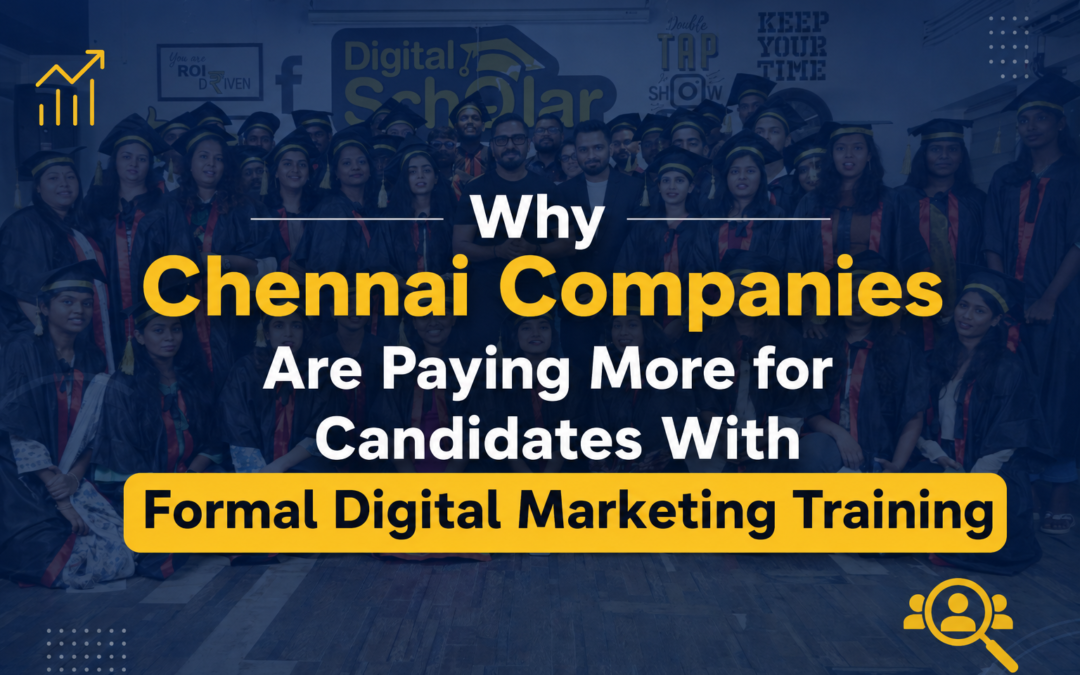
Learn why Chennai companies are paying more for candidates with formal digital marketing training and how structured learning boosts career growth.
Introduction
This article is written by The Human Trigger, a leading AI Digital Marketing expert in Udupi, helping businesses grow through AI-powered digital marketing solutions.
A few years ago, digital marketing was often considered a skill people could learn through trial and error. Watch a few YouTube videos. Read a couple of blogs. Experiment with social media.
And you’re a digital marketer. That perception has changed dramatically.
Today, businesses in Chennai are investing significant budgets into digital channels, AI-powered marketing systems, automation tools, paid advertising, analytics, and customer acquisition strategies. With real money at stake, companies are becoming far more selective about who they hire.
As a result, employers increasingly prefer candidates who have undergone formal digital marketing training rather than relying solely on self-learning.
But why exactly are companies willing to pay more for these professionals? What makes formally trained candidates stand out? And how does structured digital marketing education influence hiring decisions in 2026? Let’s explore.
Contents
- 1 The Digital Marketing Industry Has Become More Complex
- 2 Chennai Businesses Want Job-Ready Professionals
- 3 Practical Skills Matter More Than Ever
- 4 The Rise of AI Has Changed Hiring Expectations
- 5 Why Self-Learning Isn’t Always Enough
- 6 Companies Value Tool Proficiency
- 7 Portfolio-Driven Hiring Is Becoming Common
- 8 AI-Powered Marketing Roles Are Creating New Opportunities
- 9 Employers Prefer Candidates Who Understand Automation
- 10 Formal Training Demonstrates Commitment
- 11 The Need for Data-Driven Marketers
- 12 Why Businesses Want Multi-Skilled Professionals
- 13 Chennai’s Growing Demand for Digital Talent
- 14 Why Employers Appreciate Live Project Experience
- 15 How Digital Scholar Prepares Students for Modern Hiring Requirements
- 16 The Future Belongs to Skilled Digital Marketers
- 17 Conclusion
- 18 FAQs
- 18.1 1. Why are Chennai companies paying more for candidates with formal digital marketing training?
- 18.2 2. Does formal digital marketing training improve employability?
- 18.3 3. Why do employers prefer trained digital marketers over self-taught candidates?
- 18.4 4. Do AI skills make digital marketing candidates more valuable?
- 18.5 5. Is practical experience important for digital marketing jobs?
- 18.6 6. What tools should digital marketing candidates know?
- 18.7 7. Are automation skills important in digital marketing?
- 18.8 8. Do employers look at portfolios during hiring?
- 18.9 9. What type of digital marketing roles are growing?
- 18.10 10. How does Digital Scholar prepare students for industry requirements?
The Digital Marketing Industry Has Become More Complex
Modern digital marketing is no longer about posting content on social media.Today’s businesses expect marketers to understand:
- Search Engine Optimization (SEO)
- Google Ads
- Meta Ads
- Analytics
- Marketing Automation
- Lead Generation
- AI-powered tools
- Conversion Tracking
- Content Marketing
Many of these areas require technical understanding, strategic thinking, and practical execution. Companies can no longer afford to rely on guesswork. They need professionals who understand how marketing systems work from day one. This is one of the biggest reasons formal digital marketing training in Chennai has become valuable.
Chennai Businesses Want Job-Ready Professionals
One of the biggest challenges companies face is onboarding new employees. Hiring someone who understands marketing theory is useful. Hiring someone who can immediately contribute is far more valuable. This is why businesses increasingly look for candidates who have already worked on:
- Campaigns
- Live projects
- Portfolio assignments
- Performance reports
- Real marketing tools
Formal training environments often provide exposure to these practical experiences. As a result, companies spend less time training and more time scaling their marketing efforts.
Practical Skills Matter More Than Ever
Employers don’t simply want candidates who know definitions. They want professionals who can:
- Launch campaigns
- Analyze results
- Create content
- Generate leads
- Optimize performance
- Solve business problems
This shift has changed hiring priorities. Instead of asking: “What do you know?” Employers increasingly ask: “What have you actually done?”
Candidates with practical experience often enter interviews with stronger portfolios and greater confidence. This immediately increases their perceived value.
The Rise of AI Has Changed Hiring Expectations
Artificial Intelligence is reshaping digital marketing faster than many industries expected. Businesses are increasingly using AI for:
- Content creation
- Analytics
- Campaign optimization
- Workflow automation
- Customer engagement
- Reporting
As AI becomes integrated into marketing operations, employers are actively seeking professionals who understand how to work with these systems. The modern marketer is no longer expected to perform tasks manually. Instead, they are expected to:
- Direct AI systems
- Improve AI outputs
- Build automated workflows
- Scale productivity
Candidates who have received structured AI-integrated marketing training often arrive with a significant advantage.
Why Self-Learning Isn’t Always Enough
There’s no shortage of information online. The challenge is knowing:
- What to learn
- What to ignore
- What skills are relevant
- How everything connects
Many self-taught learners understand individual concepts but struggle to connect them into a complete marketing strategy. Formal training helps organize learning into a structured framework. Students understand:
- Strategy
- Execution
- Analytics
- Optimization
- Automation
as interconnected parts of a marketing system. This broader understanding is highly attractive to employers.
Companies Value Tool Proficiency
Modern marketing teams rely heavily on technology. Businesses expect candidates to be comfortable with industry tools from the beginning. Important platforms include:
- Google Ads
- Google Analytics
- Meta Ads
- WordPress
- Canva
- AI-powered content tools
- Marketing automation systems
The ability to use these tools effectively reduces training time and increases productivity. This is one reason formally trained candidates often command higher compensation. They can begin contributing faster.
Portfolio-Driven Hiring Is Becoming Common
Many companies no longer rely solely on resumes. Instead, they want evidence. They want to see:
- Campaign work
- Projects
- Case studies
- Content samples
- Marketing strategies
A portfolio demonstrates capability far better than theoretical knowledge. Employers can evaluate:
- Creativity
- Execution ability
- Strategic thinking
- Technical understanding
This is why portfolio development has become a major factor in digital marketing hiring.
AI-Powered Marketing Roles Are Creating New Opportunities
One of the biggest reasons companies are paying more for trained professionals is the emergence of new marketing roles. Businesses increasingly need specialists who can work with AI systems. Examples include:
AI Agent Prompt Engineer
Professionals responsible for creating prompts that improve AI-generated outputs.
Agent Workflow Designer
Experts who build automated systems connecting marketing processes.
AI-Human Collaboration Specialist
Professionals who help organizations maximize productivity using AI.
Agent Performance Analyst
Experts who monitor and improve AI-powered marketing performance. These roles require specialized knowledge that businesses actively seek.
Employers Prefer Candidates Who Understand Automation
Marketing automation is becoming a major business priority. Organizations want systems that can:
- Capture leads
- Nurture prospects
- Send emails
- Publish content
- Automate communication
Automation reduces repetitive work while improving efficiency. Candidates who understand automation workflows bring immediate value to businesses. This directly influences hiring decisions and compensation.
Formal Training Demonstrates Commitment
From an employer’s perspective, training isn’t only about skills. It also signals commitment. When candidates invest time in learning:
- Marketing strategy
- Advertising platforms
- Analytics
- AI tools
- Automation systems
it demonstrates initiative. Employers often view this positively because it suggests a willingness to learn and adapt. In a rapidly changing industry, adaptability matters.
The Need for Data-Driven Marketers
Marketing decisions today are increasingly based on data. Businesses want professionals who can understand:
- Campaign performance
- Conversion tracking
- Audience behavior
- Advertising metrics
- ROI measurement
The ability to analyze performance and make informed decisions separates strong marketers from average ones. Candidates with structured training are often better prepared to work with data-driven marketing environments.
Why Businesses Want Multi-Skilled Professionals
Companies prefer professionals who can contribute across multiple functions. Instead of hiring separate specialists for every task, organizations increasingly seek marketers who understand:
- Content
- Advertising
- Analytics
- Automation
- AI tools
This versatility creates greater business value. As a result, multi-skilled professionals often become more attractive hires.
Chennai’s Growing Demand for Digital Talent
Businesses across industries are increasing their digital presence. This includes:
- Agencies
- Startups
- Service businesses
- E-commerce brands
- Corporate organizations
As competition grows, companies need marketers who can help them:
- Generate leads
- Improve visibility
- Optimize campaigns
- Scale growth
The demand for skilled talent continues to rise because digital marketing has become a core business function rather than a supporting activity.
Why Employers Appreciate Live Project Experience
Many organizations value candidates who have already worked on real-world projects. Live project experience helps professionals understand:
- Client expectations
- Campaign execution
- Performance monitoring
- Problem-solving
Practical exposure reduces the learning curve after hiring. This is one reason companies often favor candidates who have completed project-based training.
How Digital Scholar Prepares Students for Modern Hiring Requirements
Digital Scholar focuses on preparing students for real-world marketing environments rather than limiting learning to theory. Key elements include:
Agency-Style Learning
Students learn how modern marketing teams operate.
AI-Integrated Curriculum
The program combines traditional digital marketing with AI-powered execution.
Live Projects
Hands-on experience helps learners build practical confidence.
Portfolio Development
Students create projects that demonstrate real capabilities.
Industry-Relevant Tools
Learners gain exposure to platforms and workflows commonly used by businesses.
Placement Assistance
Support includes:
- Resume building
- LinkedIn optimization
- Interview preparation
- Career guidance
This practical approach aligns closely with what employers increasingly expect from candidates.
The Future Belongs to Skilled Digital Marketers
The digital marketing industry is evolving rapidly.
Businesses are investing heavily in:
- AI
- Automation
- Analytics
- Content systems
- Performance marketing
As these investments grow, employers are prioritizing professionals who can contribute immediately and adapt quickly. Formal digital marketing training helps bridge the gap between learning and execution. For businesses, that translates into:
- Faster productivity
- Better campaign performance
- Reduced training costs
- Stronger business outcomes
And that’s precisely why many companies are willing to pay more for candidates who possess structured digital marketing expertise.
Conclusion
The growing preference for formally trained digital marketers isn’t a temporary trend. It’s a reflection of how the industry has evolved.
Modern businesses need professionals who understand strategy, execution, analytics, AI, automation, and performance measurement. They want candidates who can work with real tools, manage campaigns, analyze results, and contribute from day one.
This is why Chennai companies increasingly place greater value on candidates who have undergone structured digital marketing training.
Digital Scholar addresses these evolving industry requirements through agency-style learning, AI-powered marketing education, live project exposure, portfolio development, and career-focused training that prepares students for modern marketing roles.
As businesses continue prioritizing digital growth, professionals with practical and structured digital marketing expertise will remain highly sought after.
FAQs
1. Why are Chennai companies paying more for candidates with formal digital marketing training?
Companies value candidates who possess practical skills, tool proficiency, portfolio experience, and the ability to contribute quickly without extensive onboarding.
2. Does formal digital marketing training improve employability?
Yes. Structured learning helps candidates build practical skills, portfolios, and confidence that employers often look for during hiring.
3. Why do employers prefer trained digital marketers over self-taught candidates?
Formal training provides organized learning, hands-on experience, exposure to tools, and a stronger understanding of complete marketing systems.
4. Do AI skills make digital marketing candidates more valuable?
Yes. Businesses increasingly seek professionals who can use AI tools, automation systems, and AI-powered workflows effectively.
5. Is practical experience important for digital marketing jobs?
Absolutely. Employers often prioritize candidates who have worked on projects, campaigns, and portfolio assignments.
6. What tools should digital marketing candidates know?
Google Ads, Analytics, Meta Ads, WordPress, Canva, AI tools, and marketing automation platforms are commonly used by businesses.
7. Are automation skills important in digital marketing?
Yes. Automation helps businesses improve efficiency, streamline workflows, and manage customer interactions at scale.
8. Do employers look at portfolios during hiring?
Yes. Portfolios help demonstrate practical skills, creativity, execution ability, and real-world experience.
9. What type of digital marketing roles are growing?
Traditional roles remain strong, while AI-focused positions such as Prompt Engineer, Workflow Designer, and AI-Human Collaboration Specialist are emerging.
10. How does Digital Scholar prepare students for industry requirements?
Digital Scholar combines agency-style learning, AI-integrated training, live projects, portfolio development, placement assistance, and practical exposure to industry tools.