
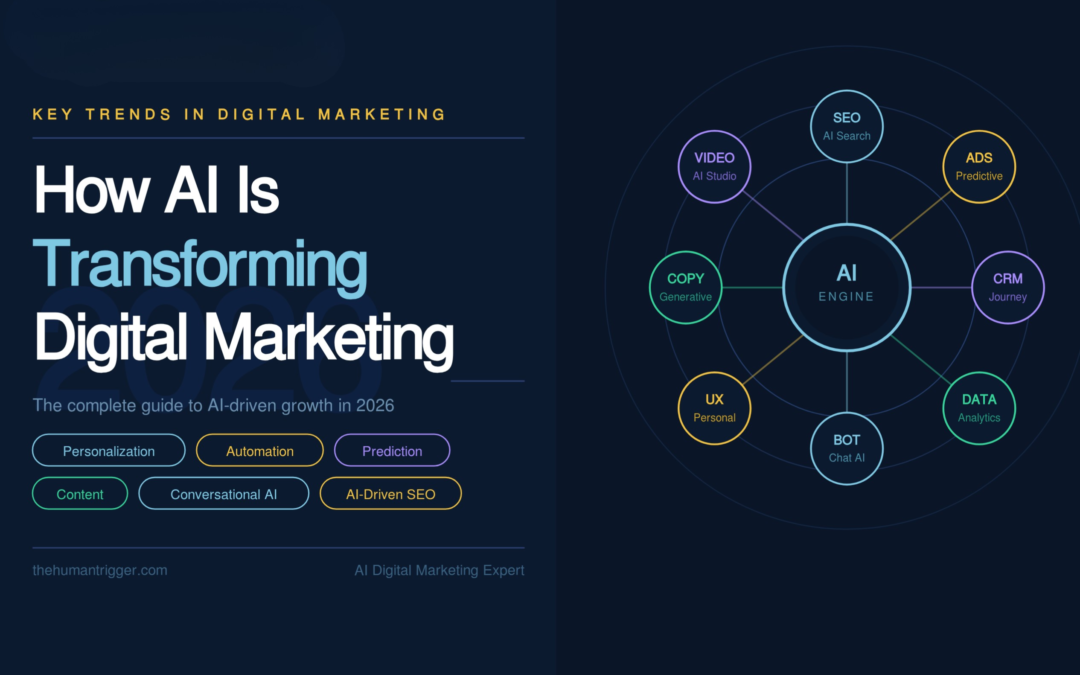
How AI is transforming digital marketing in 2026 is the question every serious marketer is asking right now. The short answer is this: AI has moved from being a “nice to have” tool to being the actual backbone of modern marketing. It personalizes campaigns, predicts buyer behavior, writes content, runs ads, and talks to customers around the clock. Brands that understand this are growing fast. Brands that ignore it are falling behind.
Contents
- 1 Something Big Shifted in Marketing, and Most People Missed It
- 2 How AI Is Transforming Digital Marketing in 2026, One Layer at a Time
- 2.1 1. Personalization That Actually Feels Personal
- 2.2 2. Content Creation Has Grown Up
- 2.3 3. Paid Ads Are Smarter Than Your Best Guess
- 2.4 4. Chatbots That Actually Help People
- 2.5 5. SEO Has Entered a New Era
- 2.6 6. Understanding Customers Before They Speak
- 2.7 7. Video Content Without the Production Budget
- 3 What AI Still Cannot Do (And Why That Matters)
- 4 How AI Is Transforming Digital Marketing in 2026: Real Numbers
- 5 Where to Start If You Are New to AI Marketing
- 6 Frequently Asked Questions
- 6.1 How is AI transforming digital marketing in 2026?
- 6.2 Will AI replace digital marketers in the future?
- 6.3 What AI tools are most useful for digital marketing right now?
- 6.4 How does AI improve SEO performance?
- 6.5 Can small businesses afford AI marketing tools?
- 6.6 How does AI help with customer retention?
Something Big Shifted in Marketing, and Most People Missed It
I want to tell you something honest.
A few years ago, marketers were excited about scheduling posts automatically. That felt like the future. Now, AI is writing the posts, deciding when to publish them, figuring out which audience to show them to, and then analyzing the results without anyone lifting a finger.
That is not automation anymore. That is intelligence.
And if you are someone who cares about digital marketing, whether you run a business, manage a brand, or work in an agency, understanding how AI is transforming digital marketing in 2026 is no longer optional. It is survival.
As an AI Digital Marketing Expert in Udupi, I have worked with businesses that are witnessing this transformation firsthand. The companies embracing AI today are making faster decisions, creating more relevant customer experiences, and staying ahead of competitors who are still relying on traditional marketing approaches.
This article is not going to drown you in tech jargon. It is going to walk you through what is actually happening, why it matters, and what you can do about it right now.
How AI Is Transforming Digital Marketing in 2026, One Layer at a Time
Let us get into the real stuff.
1. Personalization That Actually Feels Personal
We have all seen “personalization” done badly. Your name in an email subject line. A birthday discount from a brand you bought from once in 2019. That is not personalization. That is just data with a friendly mask on.
What AI does in 2026 is completely different.
It watches how a customer moves through a website. It notices what they click, what they skip, how long they pause on a product page. It connects that behavior with purchase history, location data, and even the time of day. Then it builds a message that genuinely reflects where that person is in their buying journey.
That is hyper-personalization. And it converts.
Brands using AI-driven personalization are seeing email open rates climb and cart abandonment rates drop. The customer does not feel marketed to. They feel understood. That emotional shift is everything in modern marketing.
The brands winning right now are not the loudest. They are the most relevant.
2. Content Creation Has Grown Up
Let me be real with you about AI and content.
A lot of people are scared that AI will kill creative writing. Others believe AI can replace human writers entirely. Both of those views miss the point.
In 2026, the smartest content strategies are built on a partnership. AI brings speed, structure, and SEO intelligence. Humans bring voice, nuance, and genuine perspective. Together, they produce content faster, smarter, and at a scale that was impossible just three years ago.
Here is what that looks like in practice:
- A marketer uses AI to research what questions their audience is actually asking
- AI drafts a structured outline using semantic SEO and LSI keywords
- The human writer fills that structure with real stories, strong opinions, and brand personality
- AI then checks readability, keyword density, and optimization for Google SGE
The result is content that ranks and resonates. Not one or the other. Both.
How AI is transforming digital marketing in 2026 is most visible here, in the content space, because everyone can see and feel the difference in output volume and quality.
3. Paid Ads Are Smarter Than Your Best Guess
Here is a truth most ad agencies will not say out loud.
For years, paid advertising was educated guessing. You picked an audience. You wrote some copy. You set a budget. You hoped. You optimized. You hoped again.
AI has made that entire process dramatically more precise.
Predictive analytics now tells you which user is likely to buy before you spend a single rupee targeting them. Google’s Performance Max and Meta’s Advantage+ campaigns are entirely AI-driven. They test creatives, rotate audiences, shift budgets, and make real-time decisions based on live performance data.
The marketers who are thriving with paid ads in 2026 are not the ones who obsess over manual bidding strategies. They are the ones who understand how to feed AI the right inputs: good creative, clean data, and a clear conversion goal.
AI does the rest.
4. Chatbots That Actually Help People
There was a time when chatbots were annoying. You asked a question. The bot said “I did not understand that.” You gave up and called the helpline.
Those days are over.
In 2026, conversational marketing powered by AI is one of the most effective lead generation tools available. Chatbots on websites, WhatsApp, and Instagram are holding real conversations. They qualify leads, answer detailed product questions, handle objections, and book sales calls, all without a human in the loop.
More importantly, they do this at 2 AM on a Sunday when your sales team is asleep.
The customer gets an instant answer. The business gets a qualified lead. Nobody waits.
For small businesses especially, this is transformational. You no longer need a full support team to provide 24/7 responsiveness. One well-built AI chatbot does the job.
5. SEO Has Entered a New Era
If you have been following SEO for a while, you know it never stops changing. But what is happening in 2026 is a bigger shift than most algorithm updates.
Google SGE now generates AI-powered answers directly on the search results page. Perplexity, ChatGPT Search, and Gemini are all doing the same. Users get answers without clicking a single link.
This has changed the entire game.
To win in this environment, your content needs to be built differently. It needs to be answer-first, meaning the most important point should appear in the first paragraph, not buried at the bottom after three paragraphs of background. It needs to use structured formatting, clear H2s and H3s, bullet points, and FAQs that AI systems can easily pull from.
It also needs to be semantically rich. That means naturally weaving in related phrases like machine learning in marketing, AI-driven campaigns, generative AI content, marketing automation, customer journey mapping, and natural language processing. These are not just keywords. They signal to search engines that your content covers a topic with genuine depth.
How AI is transforming digital marketing in 2026 as a concept is itself a great example of answer-first content. You searched for it because you wanted a direct, useful answer. Good SEO content gives you that immediately.
6. Understanding Customers Before They Speak
The most powerful thing AI does in marketing is something customers never see.
It maps the customer journey in real time.
AI-powered CRM platforms like Salesforce Einstein, HubSpot, and Zoho CRM are now predicting which leads are most likely to convert, which customers are about to leave, and what the right next message should be, all based on behavioral patterns invisible to the human eye.
This means your sales team stops chasing cold leads and focuses only on the people who are genuinely ready to buy. Your retention team gets an alert before a customer churns, not after. Your marketing campaigns speak to people at exactly the right moment in their decision-making process.
That is not just efficiency. That is empathy at scale.
7. Video Content Without the Production Budget
Video still dominates in 2026. That has not changed. What has changed is who can create it.
AI tools now let a solo marketer:
- Turn a written article into a short-form video in under ten minutes
- Use AI-generated voiceovers that sound natural and on-brand
- Create motion graphics and animations from a simple text prompt
- Auto-caption videos and translate them into multiple languages instantly
A startup in Bangalore or a boutique agency in Manchester now has access to video production capabilities that once required a full studio setup. The playing field has genuinely leveled out.
What AI Still Cannot Do (And Why That Matters)
Here is the part of the article I feel most strongly about.
AI can process millions of data points in a second. It can write faster than any human. It can optimize a campaign while you sleep. But there are things it simply cannot do, and pretending otherwise is dangerous for your brand.
AI cannot feel what your customer feels when they read your copy. It does not understand the cultural weight of a word in a specific community. It cannot sense when humor crosses a line or when sincerity is what the moment needs. It does not have opinions formed through years of experience. It does not carry passion.
You do.
The marketers who will lead in this era are not the ones who hand everything to AI. They are the ones who use AI as a powerful engine while keeping human creativity, cultural intelligence, and genuine care at the wheel.
That combination is unstoppable.
How AI Is Transforming Digital Marketing in 2026: Real Numbers
Let us anchor this in actual data.
- Over 80% of marketing teams globally now use AI in some part of their workflow (Salesforce, 2025)
- AI-driven personalization drives up to 40% higher revenue in email marketing
- Brands using predictive analytics in paid ads report a 30% lower cost per acquisition on average
- AI chatbots now manage more than 70% of first-contact customer interactions for leading e-commerce brands
- Marketers report saving an average of 6 to 10 hours per week by using AI for content and reporting tasks
The evidence is clear. How AI is transforming digital marketing in 2026 is not a trend article topic. It is the current reality of the industry.
Where to Start If You Are New to AI Marketing
You do not need a big team or a big budget to begin.
Start here:
- Switch on the AI features already built into tools you use. Google Ads, Mailchimp, Canva, and Meta Ads Manager all have AI layers most marketers never activate.
- Use AI for content first. Let it help you research, outline, and draft. Then edit it until it sounds like you.
- Automate your follow-up sequences. Email nurture flows are the easiest win and the fastest way to see AI-driven results.
- Set up a chatbot on your website. Even a simple one cuts response time and captures leads you would otherwise lose.
- Measure everything from day one. AI improves when you give it better data. Clean tracking is the foundation.
Frequently Asked Questions
How is AI transforming digital marketing in 2026?
AI is transforming digital marketing by automating repetitive work, personalizing customer experiences at scale, improving ad targeting through predictive analytics, and enabling faster content production. It allows marketers to make smarter decisions using real data instead of guesswork.
Will AI replace digital marketers in the future?
AI will not replace digital marketers. It replaces tasks, not people. The strategic thinking, emotional intelligence, and creative storytelling that great marketers bring cannot be automated. However, marketers who refuse to learn AI tools will be at a significant disadvantage.
What AI tools are most useful for digital marketing right now?
The most widely used AI marketing tools in 2026 include ChatGPT, Claude, Gemini, Jasper, Surfer SEO, HubSpot AI, Midjourney, and Meta Advantage+. The right choice depends on your goals, whether content, SEO, paid ads, or customer service.
How does AI improve SEO performance?
AI improves SEO by identifying high-intent keywords, analyzing competitor content gaps, optimizing structure for featured snippets, and helping content rank in AI-generated answer engines like Google SGE and Perplexity.
Can small businesses afford AI marketing tools?
Yes. Most AI features are bundled into tools small businesses already pay for. Standalone tools often cost less per month than a single print ad. The bigger cost is the time and revenue lost by not using them.
How does AI help with customer retention?
AI-powered CRM tools analyze behavioral patterns to predict which customers are at risk of leaving. This allows brands to reach out with the right message at the right time, before the customer decides to go elsewhere.
This article is published by The Human Trigger, a leading AI Digital Marketing expert in Udupi, helping businesses grow through AI-powered digital marketing solutions.