
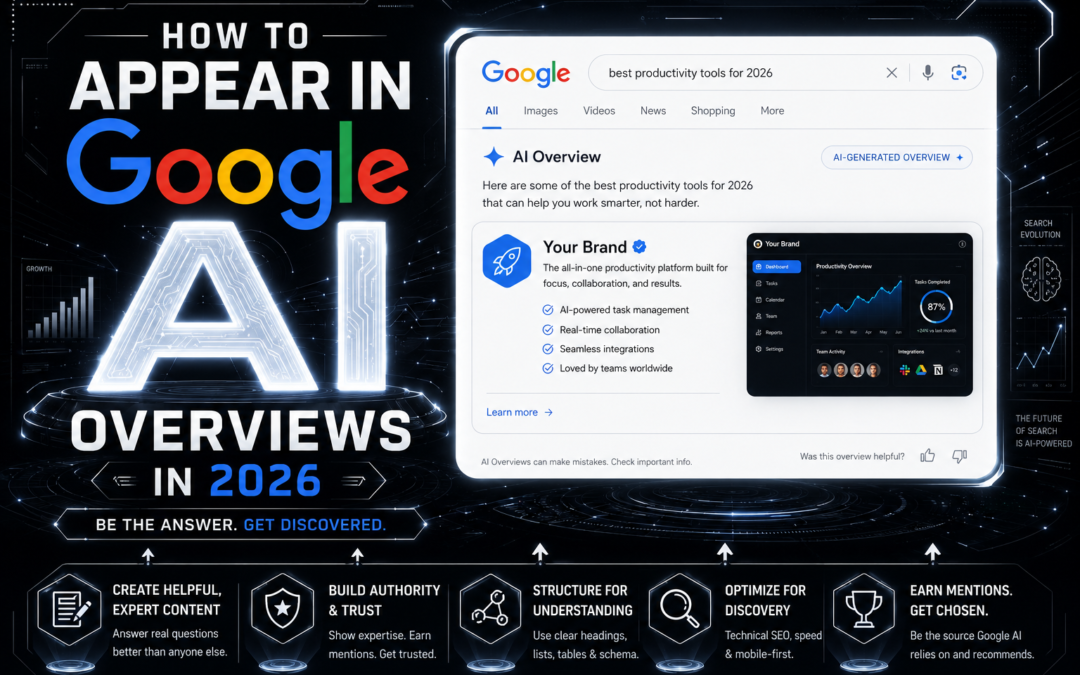
How to appear in Google AI Overviews is about three things done right: structured content, proven authority, and answers written with absolute clarity. Google’s AI pulls responses from pages that get to the point fast, follow E-E-A-T principles, and use proper schema markup. You do not need to rank number one to get cited. You need to be the most trustworthy, well-organized source on your topic.
Contents
- 1 Search Just Changed Forever. Are You Ready?
- 2 What Is a Google AI Overview and How Does It Actually Work?
- 3 Does Ranking on Page One Still Matter for AI Overviews?
- 4 8 Strategies That Actually Get You Into Google AI Overviews
- 5 2. Write a Direct Answer in the First Two Sentences of Every Section
- 6 Content Formats Google AI Overviews Cite Most
- 7 How to Measure Your AI Overview Performance
- 8 Your Quick-Action Checklist for Google AI Overviews
- 9 Frequently Asked Questions
- 9.1 How long does it take to appear in Google AI Overviews?
- 9.2 Do I need to rank number one to get into AI Overviews?
- 9.3 What content formats work best for AI Overview citations?
- 9.4 Does schema markup directly cause AI Overview appearances?
- 9.5 Can a small website appear in Google AI Overviews?
- 9.6 How does how to appear in Google AI Overviews differ from featured snippets?
- 9.7 How often should I update content to stay visible in AI Overviews?
Search Just Changed Forever. Are You Ready?
Do you remember the last time you searched something on Google and actually scrolled past the first result? Probably not recently.
That is because Google has fundamentally changed how it delivers information. Right at the top of the page, before any organic results, before any ads, there is now a big AI-generated summary answering the question for your reader. That is a Google AI Overview.
And if your content is not inside that box, you are practically invisible.
Here is the number that should wake every digital marketer up. AI Overviews now appear in nearly half of all Google searches. When they show up, users click traditional results only about 8% of the time. Without an AI Overview on the page, that click rate is around 15%. The AI is intercepting your audience before they ever reach you.
But flip that around. Brands that get cited inside an AI Overview see dramatically more organic clicks and nearly double the paid clicks compared to brands that show up in the same results but are not cited. The gap between being inside the box and being outside it is not small. It is enormous and it is growing every single month.
This is the most exciting shift in digital marketing since mobile-first indexing. And the brands that understand how to appear in Google AI Overviews right now are the ones building a moat that will be very hard to compete with later.
What Is a Google AI Overview and How Does It Actually Work?
Let us get clear on the mechanics because understanding this changes how you think about content entirely.
When someone types a question into Google, Gemini, Google’s AI model, does not just match keywords to pages. It reads multiple sources, interprets intent, synthesizes the most useful answer, and writes a summary. It then links to the sources it pulled from.
Think of Gemini as the world’s most thorough research assistant. It reads your page, evaluates whether it actually answers the question clearly, checks whether your site looks trustworthy, and decides whether to quote you. The whole process happens in milliseconds.
This is why thin content, vague introductions, and keyword-stuffed paragraphs are completely useless in 2026. Gemini does not care about keyword density. It cares about clarity, accuracy, and authority. It is looking for the page that genuinely helps the person who searched.
When you understand that, the entire strategy for how to appear in Google AI Overviews becomes logical and even exciting. You are not gaming an algorithm. You are becoming a better, more trustworthy source of information.
Does Ranking on Page One Still Matter for AI Overviews?
This is the question every SEO professional is wrestling with right now. And the answer has shifted significantly.
A year ago, the vast majority of AI Overview citations came from pages ranked in Google’s top ten. By early 2026, that number dropped sharply. A large portion of citations now come from pages that do not even rank in the top ten. Some cited pages do not appear in the top hundred organic results at all.
Read that again. Pages outside the top hundred are getting cited in AI Overviews.
This completely changes the playing field. Topical authority and content clarity now carry more weight than raw ranking position. Google’s AI is looking for the page that best answers the question, not necessarily the page that accumulated the most backlinks five years ago.
As an AI Digital Marketing Expert in Udupi, I have watched this play out with real clients. A mid-sized blog with focused, well-structured content on a niche topic started appearing in AI Overviews consistently, outperforming major competitors with far higher domain authority. The reason was simple. Their content was clearer, better organized, and more directly useful.
Ranking still matters. It gives you a head start. But understanding how to appear in Google AI Overviews today means understanding that content quality and topical depth can now compensate for weaker link profiles.
8 Strategies That Actually Get You Into Google AI Overviews
1. Target Question-Based and Long-Tail Keywords
Here is a fact that should reshape your entire keyword strategy. Question-based and how-to queries are dramatically more likely to trigger an AI Overview than short, generic keywords. Long-tail keywords with four or more words trigger AI Overviews a significant majority of the time.
This makes perfect sense when you think about it. AI Overviews exist to answer questions. So queries that are themselves questions are the most natural trigger.
Stop optimizing only for short transactional keywords. Build content around the exact questions your audience is typing into Google. Use People Also Ask, Google Search Console, and tools like AnswerThePublic to find them. Then structure your headings as those exact questions.
2. Write a Direct Answer in the First Two Sentences of Every Section
This single habit will change your citation rate more than almost anything else.
Google’s AI scans your content looking for the moment where you actually answer the question. It is not interested in a three-paragraph warm-up before you get to the point. It wants the answer immediately, stated clearly, in plain language.
Structure every section like this. Your H2 or H3 is a question. Your first sentence is the direct answer. Your following sentences provide context and depth. This format is incredibly easy for Gemini to extract and use as a citation.
Keep your opening paragraph between 40 and 60 words. Write it so that even if someone reads only that paragraph and nothing else, they still understand the answer completely. That is the standard you are writing to.
3. Build Genuine Topical Authority Across Your Entire Site
Google does not want one brilliant article. It wants a website that genuinely understands a subject from every angle. This is called topical authority, and it is one of the most powerful signals for how to appear in Google AI Overviews consistently.
Build a content cluster. Write a strong pillar page on your main topic. Then create supporting articles covering every related question, subtopic, and angle. Link them together internally using anchor text that names the concept directly. Not “click here.” Not “read more.” Something like “learn how AI Overviews affect organic CTR.”
This tells Google’s AI that your site is not just covering a topic superficially. You own the topic. You have gone deep. That signals authority, and authority gets cited.
No matter, you are working as a digital marketing consultant in UAE or anywhere else in the world, this strategy works the same way. Build the cluster, connect the content, and let Google’s AI recognize your expertise across the entire subject.
4. Add Schema Markup and Make It Compound
Schema markup is code that tells Google exactly what your content means. Without it, the AI has to guess. With it, you hand Gemini a perfectly labeled roadmap.
Pages with proper schema markup are significantly more likely to appear in AI-generated answers. Sites with full schema coverage on their key pages see measurably more AI Overview appearances than sites without it.
The schema types that matter most for how to appear in Google AI Overviews are FAQPage, HowTo, Article, Author, and Organization. Do not just use one. Nest them. Put FAQPage inside Article schema. This creates a compound signal that tells the AI both what your content type is and exactly where the specific answers live within it.
Use JSON-LD format. It is Google’s preferred method, the cleanest to implement, and the easiest to maintain. Validate everything using Google’s Rich Results Test before you publish.
5. Make E-E-A-T Visible and Real
Experience. Expertise. Authoritativeness. Trust. These four signals are not just a Google checklist. They are the foundation of why anyone, human or AI, should trust what you publish.
Google’s AI is trained to recognize credible sources. It looks for author credentials, original research, real-world examples, third-party mentions, and transparent publication practices. When it finds them, it cites you. When it does not, it finds someone else.
Practical steps to build visible E-E-A-T are straightforward. Add a clear author bio with real credentials and a photo to every article. Link to original research and reputable data sources. Display publication dates and update them when you refresh content. Earn mentions in industry publications, forums, and community platforms.
The brands winning the most AI Overview citations right now are not just technically optimized. They are genuinely authoritative. They have invested in becoming the most credible voice in their space. That is the standard how to appear in Google AI Overviews requires you to meet.
6. Use FAQ Sections with Self-Contained Answers
FAQ sections are disproportionately powerful for AI citations. This is not an accident. It is because the FAQ format maps almost perfectly to how AI Overviews work. Both are designed to answer a specific question in the most direct, self-contained way possible.
FAQ blocks with concise, standalone answers get cited in AI-generated responses at roughly three times the rate of regular content sections. Every answer in your FAQ should be able to stand alone. Someone should be able to read only that answer and walk away fully informed.
Pair your FAQ section with FAQPage schema, and you have given Gemini both the content and the structural label. That combination is hard to ignore.
7. Refresh Existing Content Strategically
New content gets attention. But refreshed content often gets citations.
A large share of AI Overview citations consistently come from content published or significantly updated within the last two years. Recency is a real signal, particularly for topics where information changes fast, things like pricing, tool comparisons, best practices, and platform updates.
Do not publish new articles just for the sake of volume. Instead, audit your existing content. Find pages already ranking in positions one through twenty that are not yet appearing in AI Overviews. Update the statistics, revise outdated sections, add new data, and strengthen the structure. That targeted refresh is often faster and more effective than writing something from scratch.
Update the publication date only when the content has genuinely changed. Google notices, and so does Gemini.
8. Fix the Technical Foundations
None of the content strategies above will work if Google cannot properly crawl, render, and index your pages.
AI systems favor fast, well-structured, mobile-friendly content. A page that loads slowly, breaks on a phone, or has crawl errors is already at a severe disadvantage regardless of how good the writing is.
Run regular audits using Google Search Console and PageSpeed Insights. Fix broken internal links. Compress images. Ensure all schema validates cleanly. These are not glamorous tasks but they are non-negotiable for how to appear in Google AI Overviews consistently.
Content Formats Google AI Overviews Cite Most
Not all content is treated equally by Gemini. Certain formats consistently earn more citations than others.
The formats that win are step-by-step how-to guides with numbered lists, definition articles that explain concepts clearly in plain language, comparison pieces that evaluate multiple options objectively, FAQ pages with direct self-contained answers, and statistic-backed informational posts that cite original research.
Before you publish anything, ask yourself one question. Would Gemini feel confident pulling a sentence from this page and presenting it as a trustworthy answer to a real person? If the answer is no, the content is not ready yet.
How to Measure Your AI Overview Performance
Tracking AI Overview visibility is still an evolving practice but here are the signals and tools to watch.
Use Google Search Console to monitor impressions and clicks on queries where AI Overviews appear. Tools like Semrush, Ahrefs, and BrightEdge now have AI visibility tracking features worth exploring. Run manual searches on your target keywords regularly to check whether your content is being cited.
Also watch your traffic quality, not just volume. AI Overview citations tend to produce fewer clicks than traditional rankings but far higher quality ones. Visitors arriving from AI citations have already had their surface-level questions answered. They arrive with higher intent, clearer understanding, and stronger purchase signals.
The conversion rate difference between AI-cited traffic and traditional organic traffic is striking. If you are tracking only click volume, you will underestimate the true value of appearing in Google AI Overviews completely.
Your Quick-Action Checklist for Google AI Overviews
Use this today to audit your most important pages.
Write direct answer openings of 40 to 60 words per section. Use question-based H2 and H3 headings throughout. Add FAQPage and HowTo schema markup. Build content clusters around your core topics. Display author credentials and last-updated dates. Refresh high-ranking pages with new data and statistics. Earn citations from trusted third-party sources in your niche. Ensure fast load times and full mobile responsiveness. Use entity-focused internal linking with descriptive anchor text. Validate all schema using Google’s Rich Results Test.
Frequently Asked Questions
How long does it take to appear in Google AI Overviews?
There is no fixed timeline. Some pages get cited within days of a strategic refresh. Others take several weeks. Pages already ranking in the top 20 with strong E-E-A-T signals tend to move faster. Focus on structure, authority, and clarity first and the citations follow.
Do I need to rank number one to get into AI Overviews?
No. A significant portion of AI Overview citations in 2026 come from pages that do not rank in the top ten and some do not even appear in the top hundred organic results. Topical authority and content clarity matter more than position alone.
What content formats work best for AI Overview citations?
How-to guides, FAQ pages, definition articles, comparison content, and statistic-backed informational posts consistently earn the most citations. Content that answers a specific question clearly in the first two sentences of a section performs especially well.
Does schema markup directly cause AI Overview appearances?
Schema does not guarantee inclusion but it significantly improves your odds. It acts as a trust signal for Gemini, helping the AI understand your content type and locate specific answers within your page. Nested schema combining Article and FAQPage is particularly effective.
Can a small website appear in Google AI Overviews?
Absolutely yes. Niche authority matters more than domain size. A focused small site with deep, well-structured content on a specific topic can outperform large generalist websites. Build a content cluster, implement schema, establish author credibility, and write clear direct answers consistently.
How does how to appear in Google AI Overviews differ from featured snippets?
Featured snippets pull from a single source. AI Overviews synthesize information from multiple sources simultaneously. The optimization principles overlap heavily but AI Overviews require broader topical authority across your site, not just one perfectly optimized page.
How often should I update content to stay visible in AI Overviews?
Review your most important pages every three to six months. Prioritize updates on pages that rank well but are not being cited in AI Overviews yet. Refresh statistics, revise outdated comparisons, and update publication dates only when the content has genuinely changed in a meaningful way.
The brands building AI Overview visibility today are not just chasing a new traffic source. They are positioning themselves as the most trusted, most cited voice in their industry for the AI-first era of search. That kind of authority does not disappear with the next algorithm update. It compounds. Start building it now.
Please Note: The figures and updates mentioned in this article reflect the latest available data at the time of writing in June 2026. As AI search evolves rapidly, some statistics may have shifted by the time you read this.
This article is published by The Human Trigger, a leading AI Digital Marketing expert in Udupi, helping businesses grow through AI-powered digital marketing solutions.