

So, you bought the tools. You subscribed to the paid ChatGPT account, you bookmark every new prompt-engineering list on Twitter, and you might even have a folder full of bookmarklets. Yet, at the end of the week, you feel just as behind as you did before.
What happens is that we treat AI like a faster typewriter. We ask it to write an email, copy-paste the output, fix the grammar, and hit send. That is not workflow automation. That is just point-and-click assistance. If you want to scale a digital marketing presence without burning out, you need to stop thinking in prompts and start thinking in systems.
Because let’s face it: prompting ChatGPT for single tasks is a trap. It feels productive because you get a block of text in ten seconds, but the cognitive friction of copying, pasting, formatting, checking for hallucinations, and editing is a hidden time-drainer. To win back ten to fifteen hours every week, you must construct integrated AI marketing workflows.
According to me, the secret to modern SEO and content marketing is not generating more volume; it is building structured AI marketing workflows that connect data sources, run execution loops, and implement strict human gates. This is how we move from basic content creation to building a sustainable, high-growth engine.
Contents
- 1 The Trap of “Point-and-Click” AI (Why Simple Prompts Fail)
- 2 The Core Framework: Agentic Marketing Loops (AML) and Human-in-the-Loop (HITL) Gates
- 3 Workflow 1: The Topical Authority Content Engine
- 4 Workflow 2: The Omnichannel Social Repurposing Loop
- 5 Workflow 3: Automated Competitor Intelligence and SWOT Tracking
- 6 How to Build the Intelligence Loop
- 7 The Core Tech Stack: Building Your Automation Engine
- 8 Practical Checklist: How to Start Saving Time Today
- 9 FAQ: Common Questions on AI Workflows
- 10 Conclusion: Stop Prompting, Start Systematizing
The Trap of “Point-and-Click” AI (Why Simple Prompts Fail)
Most marketers approach AI with a task-based mindset. They open an AI chat window, type a quick prompt like “write a blog post about email marketing,” and hope for the best.
What they get is a generic draft that requires massive editing. By the time they fix the tone, check the facts, and insert keywords, they have barely saved any time. This task-based approach does not scale because it does not connect to your existing data or systems.
When you rely on manual, disconnected prompts, you create a fragmented process. You are still the bottleneck. You must manually copy the keyword research, paste it into the prompt, copy the draft, paste it into your CMS, and manually find images. This is where hours are lost.
To save serious time, you must design AI marketing workflows that connect these steps programmatically. Instead of prompting an AI to write a post, you build a workflow that pulls a target keyword, generates an SEO brief, drafts the content based on that brief, checks keyword density, and drafts social media summaries, all in one automated sequence.
By moving from manual prompting to structured AI marketing workflows, you shift your role from a copywriter to a systems director. You spend your time designing, auditing, and optimizing the systems rather than doing the repetitive execution.
The Core Framework: Agentic Marketing Loops (AML) and Human-in-the-Loop (HITL) Gates
Before building, we must understand the structure of modern AI marketing workflows. A simple automated flow is linear: a trigger happens, a tool acts, and an output is saved. For example: a new row is added to Google Sheets, OpenAI generates a caption, and it gets saved to Buffer.
While this works for basic administrative tasks, it fails for complex marketing campaigns. Why? Because AI models hallucinate. They lose tone, they ignore SEO guidelines, and they produce generic fluff.
To build high-value systems, we use Agentic Marketing Loops (AML) within our AI marketing workflows, combined with Human-in-the-Loop (HITL) Gates.
An Agentic Marketing Loop is a multi-step, self-correcting automation where one AI agent’s output becomes the input and critique criteria for the next. For example, a research agent gathers data, a writing agent drafts the text, and a compliance agent checks the draft against your brand guidelines. If the compliance agent detects issues, it sends the draft back to the writing agent with specific edit instructions.
However, these AI marketing workflows are never fully autonomous. We build “Gates” where a human must review, refine, and approve the output before it moves to the next stage. This ensures you maintain brand authority and trust, which is essential for AI marketing ethics in 2026 where transparency and human oversight are paramount.
By designing these gates into your AI marketing workflows, you get the speed of AI automation with the quality and security of human expertise. You protect your brand from generic output while saving hours on manual operational tasks. You are not letting the AI run wild; you are using it to draft, analyze, and package information so that your human review is fast and high-impact.
Let us look at three practical AI marketing workflows you can implement today to reclaim your time.
Workflow 1: The Topical Authority Content Engine
Building topical authority is the gold standard for ranking in search today. You cannot rely on single, isolated articles; you need a cluster of tightly related, high-value pages. In the past, mapping a topical cluster and writing the articles took weeks of research and drafting.
With structured AI marketing workflows, you can compress this timeline into hours. We can design an AI content creation workflow that handles everything from keyword research to drafting.
Step 1: Cluster Mapping
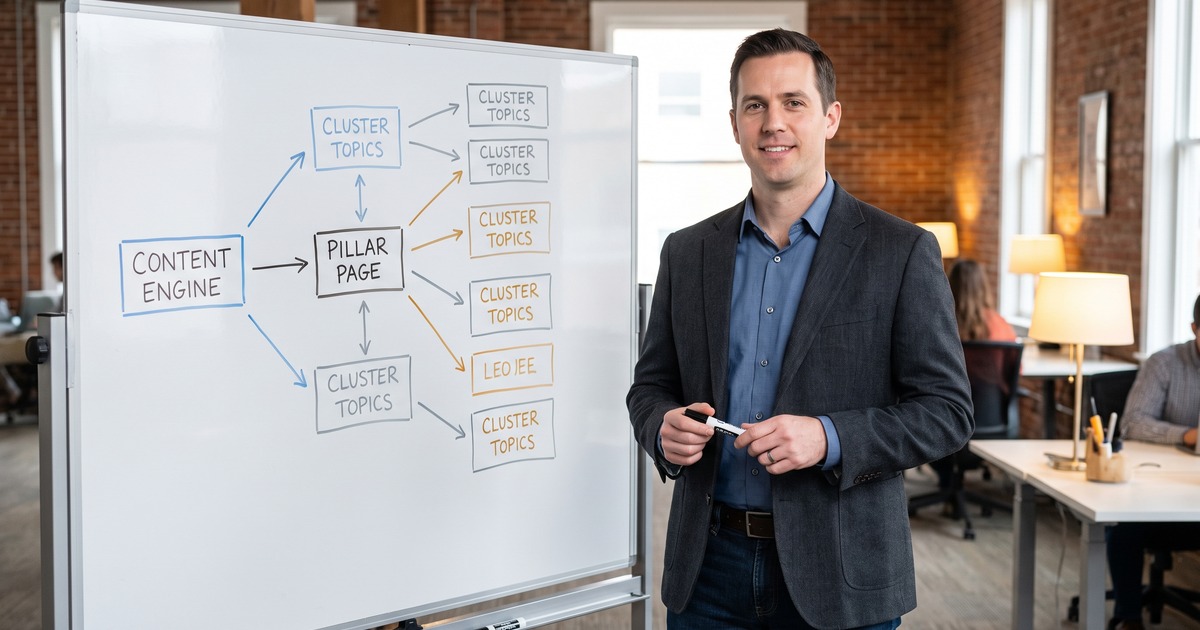
We start by scraping search queries and clustering them by intent. Instead of analyzing hundreds of keywords manually, our AI marketing workflows feed the raw keyword data into an LLM with a specific categorization prompt. The AI clusters them into primary pillars and supporting subtopics, mapping the exact internal linking structure required.
This process directly reinforces your strategy for entity SEO and topical authority, ensuring Google understands the semantic relationship between your pages.
Step 2: Automated SEO Briefing
Once the clusters are mapped, a secondary agent in our AI marketing workflows analyzes the current search engine results pages (SERPs) for each keyword. It extracts the heading structures of the top five ranking pages, identifies the questions people ask (using People Also Ask patterns), and compiles an SEO brief.
This brief contains the target headings, required keyword density (aiming for 1% to 2% for the primary keyword), and semantic terms. It is a critical input that ensures your content is optimized to appear in Google AI Overviews in 2026 and other search systems.
Step 3: Drafting and Human Gate 1
The brief is passed to a specialized writing agent configured with your brand voice guidelines. The agent drafts the article section by section, ensuring the primary keyword is in the introduction and subheadings.
Once the draft is complete, it stops at the first Human Gate. As a human-in-the-loop, you do not rewrite from scratch. You read the draft to inject personal experience, verify accuracy, remove any AI-like phrasing, and check the tone. You check if the article provides real value, then approve it for the next phase.
+------------------------+      +------------------------+      +------------------------+
|  Keyword / Topic Input | ---> |  AI Brief Generator   | ---> |  AI Content Writer     |
+------------------------+      +------------------------+      +------------------------+
                                                                            |
                                                                            v
                                                                +------------------------+
                                                                |   Human Review Gate    |
                                                                +------------------------+
By using these AI marketing workflows to handle the research and initial drafting, you save up to eight hours per article. Your focus shifts from staring at a blank page to editing and refining a structured draft.
Workflow 2: The Omnichannel Social Repurposing Loop
Writing a great blog post is only half the battle. If you want to maximize its reach, you need to repurpose it into newsletter summaries, LinkedIn articles, X threads, and scripts for short-form video. Doing this manually takes hours of copying, editing, and formatting.
We can automate this process by building specialized AI marketing workflows using an orchestration platform like Zapier or Make.com.
The Automated Repurposing Recipe
1. Trigger: A new post is published on your WordPress website.
2. Action 1 (Data Fetch): The automation pulls the full HTML content of the post.
3. Action 2 (AI Processing): The content is sent to an LLM via API. We use a system prompt that defines the brand voice and outlines the social templates.
– The AI generates a 200-word newsletter summary with a clear call-to-action.
– It drafts a structured LinkedIn post highlighting the three main takeaways.
– It writes a five-part X thread using punchy, hook-driven language.
4. Action 3 (Draft Staging): The workflow pushes these social media drafts directly into your social scheduler (like Buffer or Hootsuite) as “Drafts.”
The Human Gate
The social scheduler acts as your Human Gate in these AI marketing workflows. You receive a notification that drafts are ready for review. You open the scheduler, tweak the hooks to sound more natural, ensure the formatting is correct, and approve the schedule.
This workflow reduces the time spent on content distribution by 80%. Instead of spending hours drafting social posts, you spend five minutes reviewing and tweaking them. It is a highly practical implementation of modern AI marketing tactics that work, allowing small teams to operate with the output of a full marketing department.
By implementing these AI marketing workflows, you ensure that every major piece of content you write gets fully promoted across all your social channels without adding to your weekly workload.
Workflow 3: Automated Competitor Intelligence and SWOT Tracking
Keeping tabs on competitor updates is exhausting. Marketers spend hours visiting competitor websites, checking social media profiles, and reading product announcements. Often, by the time you notice a competitor’s new positioning, you are already playing catch-up.
We can build automated AI marketing workflows that track competitors, run SWOT analyses, and deliver insights directly to your inbox.
How to Build the Intelligence Loop
1. The Scraper Trigger:
Set a weekly cron job (using a tool like Apify or a custom script) to scrape the homepages, blog index pages, and pricing pages of your top five competitors.
2. The Comparison Engine:
Feed the scraped text from the current week and the previous week into an LLM. Ask the AI to detect changes: Did they update their pricing? Did they launch a new service? Did they change their hero headline?
3. The SWOT Agent:
If changes are detected, a secondary agent runs a SWOT analysis based on the competitor’s updates. It analyzes how their new positioning impacts your services and suggests adjustments for your own campaigns.
4. The Digest Deliverable:
The workflow formats these findings into a clean markdown report and sends it to your Slack or email.
This gives you a continuous stream of competitive data. Instead of performing manual searches, you spend ten minutes reviewing a structured, actionable report. These AI marketing workflows directly feed into your broader AI marketing strategy, keeping you agile and proactive.
By establishing these AI marketing workflows for competitor tracking, you eliminate the need for manual monitoring and ensure your team is always aware of market shifts.
The Core Tech Stack: Building Your Automation Engine
To build these AI marketing workflows, you do not need to write complex code or hire a software engineer. The modern no-code and low-code ecosystem provides all the tools required to stitch AI systems together.
According to me, these are the essential platforms for building your AI marketing workflows:
- Orchestration (Make.com and Zapier): These are the glue of your systems. Zapier is great for simple, integration-heavy tasks. Make.com is ideal for complex, multi-branching AI marketing workflows that require logic and database lookups.
- Agent Orchestration (Relevance AI or Gumloop): While Zapier connects tools, agentic platforms are designed to run complex AI marketing workflows. They allow you to build custom agents that scrape webs, write briefs, and verify outputs.
- Large Language Models (APIs): Instead of using the web interface of ChatGPT or Claude, connect directly to their APIs (OpenAI API or Anthropic API). This gives you control over system instructions, temperature, and formatting, ensuring consistent outputs across all your AI marketing workflows.
- WordPress REST API: By utilizing the WordPress API, you can programmatically upload drafts, update categories, and set metadata fields directly from your automated systems.
To explore how these tools fit into a marketer’s daily tasks, read our guide on what an AI digital marketing expert does to manage these systems.
Practical Checklist: How to Start Saving Time Today
If you try to automate all your marketing tasks at once, you will build fragile systems that break. Start small, test thoroughly, and scale gradually. Use this step-by-step checklist to guide your implementation of AI marketing workflows:
- Identify the bottleneck: Track your time for three days. Find the most repetitive, high-friction task (e.g., writing newsletter summaries or extracting keywords).
- Document the manual process: Write down the exact steps you take to complete this task. You cannot automate AI marketing workflows that you cannot explain clearly.
- Build the linear flow: Use Zapier or Make.com to connect the trigger and the AI action.
- Insert the Human Gate: Ensure the AI output is saved as a “draft” or sent to you for review before it goes live.
- Test and iterate: Run the workflow five times. Adjust the prompts and instructions until the output is consistently close to your standards.
- Scale to loops: Once the linear flow is stable, connect a secondary agent to critique the output or run subsequent tasks.
By adopting this operational discipline, you transform your marketing from a series of manual chores into a scalable system. You reclaim your time to focus on strategy, creative direction, and building relationships. The implementation of AI marketing workflows is not a one-time project; it is a continuous practice of refining your marketing operations.
FAQ: Common Questions on AI Workflows
What are the best AI workflows for marketing?
The best AI marketing workflows are those that eliminate repetitive data processing and drafting. These include automated SEO brief generation, multi-channel social media repurposing from a single blog post, and automated competitor monitoring. By focusing on these high-friction administrative tasks, you save hours while maintaining quality control
How do AI marketing workflows save time?
AI marketing workflows save time by automating the extraction, restructuring, and formatting of content. Instead of manually copy-pasting text, running multiple prompts, and staging drafts, the workflow handles the heavy lifting. You only step in at designated review gates to perform final edits and approvals.
Can AI automate entire marketing campaigns?
AI can automate the execution, drafting, and scheduling of campaigns within structured AI marketing workflows, but it should never run entirely unsupervised. Human oversight is essential to guide the overall strategy, review the messaging for ethical alignment, and ensure the factual accuracy of all claims. Autonomous loops are powerful, but they require human guardrails.
What tools are needed for AI workflow automation?
To build these automations and run your AI marketing workflows, you need an orchestration tool like Zapier or Make.com to connect your applications, API access to LLMs like OpenAI or Anthropic, and tools like Apify for web scraping. These can be combined with agentic platforms like Relevance AI or Gumloop to run multi-step AI tasks.
Conclusion: Stop Prompting, Start Systematizing
The future of digital marketing belongs to those who build systems. The marketers who rely on manual copy-pasting will find themselves overwhelmed by the sheer volume of content and channels.
According to me, the only way to stay ahead is to build custom AI marketing workflows that act as force multipliers. You do not need to be a software developer to do this; you just need to think structurally about your daily tasks. By connecting your tools, using APIs, and building strict human gates, you can easily save ten to fifteen hours every week.
If you are looking to build a high-performance content engine for your brand, explore the best AI content strategy platforms for agencies to guide your tool selection. Or, reach out to The Human Trigger to discuss building bespoke AI marketing workflows tailored to your marketing objectives.
It is time to close the ChatGPT tab, look at your operations, and start building your automation engine.